

Why Your Website Matters From Day One
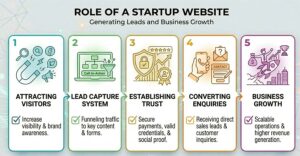
For a startup, a website is often the first real interaction people have with your business.
Before someone speaks to you, sends an enquiry or considers working with you, they will likely visit your website.
That first impression matters.
A clear and professional website builds credibility. It reassures visitors that your business is legitimate and worth considering.
Without this, even strong ideas can struggle to gain traction.
Your website also plays a key role in lead generation. It should guide visitors toward taking action, whether that is making an enquiry, booking a call or signing up for more information.
It supports your marketing efforts as well. Whether you are running ads, sharing content or networking, your website acts as the central point where people learn more and decide what to do next.
In short, your website is not just an online presence. It is a core part of how your startup grows.
Core Elements of a Startup Website
A startup website does not need to be large, but it does need to be effective.
Focusing on a few core elements ensures the site delivers value from the beginning.
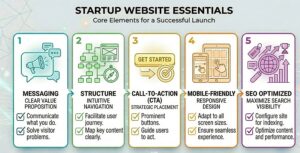
1. Clear Value Proposition
Visitors should understand what you do within seconds of landing on your website.
This means clearly communicating your offer, who you help and why it matters.
Vague messaging creates confusion. Clear messaging builds confidence.
2. Simple Structure
A startup website should be easy to navigate.
In most cases, a simple structure is enough. A homepage, services or product pages, an about section and a contact page.
This keeps the experience straightforward and avoids overwhelming visitors.
3. Strong Calls to Action
Every page should guide users toward the next step.
Whether it is contacting you, booking a call or making a purchase, the action should be clear and easy to take.
Without this, visitors may leave without engaging.
4. Mobile Friendly Design
Most users will access your website on mobile devices.
If the site is difficult to use on smaller screens, it will affect both user experience and conversions.
Designing with mobile in mind ensures a smoother experience for your audience.
5. Basic SEO Setup
Even at an early stage, your website should be structured to support search visibility.
This includes clear page titles, organised content and a logical site structure.
SEO does not need to be complex at the start, but it should not be ignored.
Common Mistakes Startups Make With Web Design

Many startups run into the same issues when building their first website.
Understanding these mistakes early can help you avoid wasting time and budget.
One of the most common problems is overcomplicating the website. Adding too many pages, features or ideas at once can slow down the process and create confusion.
Another issue is focusing too much on design. While visual quality matters, clarity and structure are more important for early stage results.
Messaging is often overlooked. Startups sometimes struggle to explain what they do clearly, which makes it harder for visitors to engage.
Choosing the wrong platform can also create problems. Some solutions are too limited, while others are unnecessarily complex for a startup’s needs.
Trying to do everything at once is another common mistake. A website should evolve over time. Starting with a focused version is usually more effective.
Avoiding these pitfalls helps keep the project aligned with your goals.
How to Build a Startup Website the Right Way
Building a website for your startup does not need to be complicated. A simple, structured approach works best.
Start by defining your goals. What do you want the website to achieve? This could be generating leads, selling products or building awareness.
Next, clarify your messaging. Be clear about what you offer and who you help. This forms the foundation of the website.
Plan the structure of the site. Decide which pages are needed and how users will move through them.
Design with the user in mind. Focus on clarity, ease of use and guiding visitors toward action.
Finally, launch and improve. A website is not a one time project. It should evolve based on feedback and performance.
This approach keeps the process manageable and aligned with business needs.
Budget Considerations for Startup Websites

One of the biggest questions startups ask is how much they should spend on a website.
The honest answer is that it depends on what the business needs right now and where it is heading.
Startup budgets are often limited, which means every decision needs to be practical. The goal is not to build the perfect website from day one. It is to build something that works and supports growth.
A very low cost website may seem attractive at the start, but it often creates problems later. Poor structure, weak messaging and limited functionality can hold the business back as it grows.
On the other hand, investing too much too early can also be risky. Spending heavily on features you do not yet need can reduce flexibility and delay launch.
The key is balance.
Startups should focus their budget on the elements that directly impact performance. Clear messaging, user experience and a solid structure matter far more than complex features.
As the business grows, the website can evolve. Additional functionality, deeper SEO work and design refinements can be added over time.
This approach keeps costs manageable while ensuring the website still delivers value.
Scaling Your Website as Your Startup Grows
A startup website is not a fixed asset. It should grow alongside the business.
As your startup gains traction, your website will need to evolve to support new goals.
This might include adding new service pages, expanding product listings or creating landing pages for marketing campaigns. These additions help improve visibility and support more targeted messaging.
Search engine optimisation becomes more important as well. As your content grows, your website should be structured to support rankings and attract organic traffic.
User experience should also improve over time. Small adjustments to layout, navigation and calls to action can have a significant impact on conversions.
Brand development plays a role too. As your startup becomes more established, your website should reflect a more refined identity.
Scalability is key. The platform and structure you choose early on should allow for growth without requiring a complete rebuild too soon.
A website that can adapt will continue to support your business instead of holding it back.
How Design Hero Supports Startups in Glasgow
For startups, clarity and direction matter more than anything else.
At Design Hero, the focus is not just on building websites. It is on building websites that support real business outcomes.
The process starts with understanding your goals. What you offer, who you are targeting and what success looks like for your business.
From there, the website is structured around clarity. Messaging is prioritised so visitors immediately understand what you do and why it matters.
Design decisions are guided by usability and performance. The goal is not to create something that simply looks good, but something that works.
Everything is built with growth in mind. As your startup evolves, your website should be able to evolve with it.
You also deal with one point of contact throughout the process. This keeps communication simple and avoids the confusion that often comes with larger agencies.
For startups in Glasgow and across Scotland, this approach provides a practical and reliable foundation for building an online presence.
Want a trust web design partner for your new business – Contact for free consultation
Startup Website Checklist
For founders reviewing their website or planning a new one, a simple checklist can help keep everything on track.
- Clear message that explains what you do within seconds
- Simple structure with essential pages only
- Strong calls to action guiding users to the next step
- Mobile friendly design that works on all devices
- Easy navigation without confusion
- Fast loading pages for better user experience
- Basic SEO setup for visibility
- Consistent branding across all pages
- Platform that allows future growth
- Focus on performance rather than unnecessary features
If your website meets these criteria, it is likely supporting your startup effectively.
If not, it may be time to rethink your approach.
Conclusion
For startups in Glasgow, a website should not be a complicated or overwhelming project.
It should be a clear, focused tool that supports your business from day one.
Too many startups either overbuild and waste budget or underthink and miss opportunities. The right approach sits in the middle. Build what you need now, but plan for where you are going.
A strong startup website is built on clarity, structure and usability. It communicates your value, builds trust and guides visitors toward action.
As your business grows, your website should grow with it.
If you are launching a startup or struggling with an existing website, it may be time to take a step back and reassess what your website is actually doing for your business.
Design Hero works with startups across Glasgow and Scotland to build websites that are simple, effective and designed for growth.
If you want a website that supports your business properly, not just something that exists online, it starts with the right strategy.