


Why Most WordPress Websites Fail to Convert?
Before improving conversions, you need to understand why they fail.
Most underperforming websites share the same patterns.
Users land on a page and within seconds:
- They are unsure what the business actually does
- They cannot find what they need quickly
- There is no clear next step
- The page feels cluttered or overwhelming
- The site loads slower than expected
These are not design problems. They are structural problems.
Many websites are built as static pages rather than decision-making journeys. They present information, but they do not guide users.
This is why businesses often experience traffic without results.
The issue is not visibility. It is conversion.
These patterns are consistent across industries and align with broader structural issues discussed in the competition business guide, where clarity and user flow directly influence outcomes.
What a CRO-Focused WordPress Consultant Actually Changes?
A WordPress consultant focused on conversion does not begin with aesthetics.
They begin with questions:
- What is the goal of this page?
- What action should the user take?
- What is stopping them from taking it?
- Where are users dropping off?
From there, they improve the entire system.
This includes:
- Page structure
- Messaging clarity
- User journey
- Technical performance
- Content hierarchy
- Conversion triggers
This is why WordPress conversion optimization is not a single task. It is a system-wide improvement process.
Design becomes a supporting element, not the main focus.
1. UX Improvements That Reduce Friction and Increase Action
User experience is one of the most powerful levers for improving conversions.
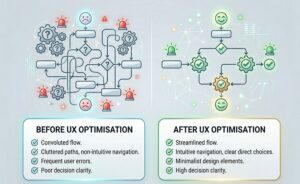
Most websites unintentionally create friction.
Examples include:
- Too many choices on one page
- Confusing navigation
- Large blocks of unreadable text
- Inconsistent layout patterns
- Hidden calls to action
A WordPress consultant removes this friction.
They simplify the experience so users can:
- Understand the offer quickly
- Navigate without thinking
- Take action confidently
For example:
A homepage may be redesigned to:
- Lead with a clear value proposition
- Highlight one primary action
- Reduce visual clutter
- Guide the user step by step
Even small UX changes can significantly improve conversion rates.
2. Landing Page Optimisation That Matches Intent
Landing pages are where conversion decisions are made.
Most underperforming landing pages fail because they:
- Do not match user intent
- Lack clarity in messaging
- Include too many distractions
- Do not build trust quickly
A WordPress consultant improves landing pages by aligning them with intent.
For example:
If a user searches for a service, the landing page should:
- Clearly explain that service
- Show credibility immediately
- Provide a clear next step
- Remove unnecessary distractions
Strong landing pages follow a structure:
- Headline that explains value
- Supporting content that builds trust
- Clear call to action
- Minimal friction
This is a core part of improve website conversions WordPress strategies.
3. Funnel Strategy: Turning Visitors Into Customers
Most websites are not designed as funnels.
They are collections of disconnected pages.
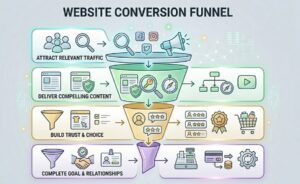
A WordPress consultant restructures the website into a journey.
Typical funnel structure:
1. Entry point from search or ads
2. Landing page aligned with intent
3. Supporting content that builds trust
4. Clear conversion action
Each step has a purpose.
Without this structure, users get lost.
With it, conversion rates increase because users are guided rather than left to figure things out themselves.
4. A/B Testing: Improving Results Through Data
One of the biggest differences between design and conversion optimisation is testing.
Design is often subjective.
Conversion optimisation is measurable.
A WordPress consultant will test:
- Headlines
- Button text
- Page layouts
- Pricing presentation
- Form fields
For example:
Changing: Contact Us, to: Get Your Free Quote Today can increase conversions significantly.
A/B testing allows continuous improvement.
This is where a CRO WordPress consultant creates long-term value.
The goal is not one perfect version. It is ongoing optimisation.
5. Performance Optimisation That Increases Conversions Instantly
Speed has a direct impact on conversions.
A delay of even one second can reduce engagement and increase bounce rate.
Many WordPress sites suffer from:
- Heavy themes
- Too many plugins
- Unoptimised images
- Poor hosting
A consultant improves performance by:
- Cleaning up unnecessary code
- Optimising assets
- Improving server response
- Implementing caching
These improvements often produce immediate results.
Better speed means:
- Higher engagement
- Lower drop-off
- Increased conversions
6. CRO and SEO Integration for Better Results
SEO and conversion optimisation are often treated separately.
This creates inefficiency.
- SEO drives traffic.
- CRO converts traffic.
A WordPress consultant integrates both.
This means:
- Pages are structured for search intent
- Content matches what users are looking for
- Internal linking supports navigation
- UX supports engagement
This aligns with principles explained in SEO benefits, where structure and intent drive performance.
When SEO and CRO work together, both traffic and conversions improve.
7. Stronger Calls to Action That Drive Behaviour
Most websites use weak calls to action.
Examples:
- Learn More
- Submit
- Click Here
These do not create urgency or clarity.
A consultant improves CTAs by making them:
- Specific
- Benefit-driven
- Action-focused
For example:
Instead of: “Submit”, Use: Get Your Free Quote in 24 Hours
Clear CTAs reduce hesitation and increase action.
8. Identifying and Fixing Drop-Off Points
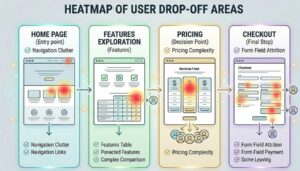
Conversion loss often happens silently.
Users:
- Abandon forms
- Leave pages halfway
- Exit before completing actions
A WordPress consultant identifies these drop-off points using:
- Analytics
- Heatmaps
- Behaviour tracking
Then fixes them by:
- Simplifying forms
- Improving clarity
- Reducing steps
- Increasing trust signals
9. Aligning Design With Business Goals
Most websites are designed visually.
High-performing websites are designed strategically.
A consultant ensures:
- Every page has a purpose
- Every section supports conversion
- Design aligns with business objectives
This transforms the website from:
Aesthetic asset → Revenue-generating system
10. Turning Your Website Into a Conversion Engine
The ultimate goal is not a better-looking site.
It is a better-performing one.
A WordPress consultant helps transform your site into:
- A lead generation tool
- A sales support system
- An SEO asset
- A scalable platform
This is where real ROI is created.
Want help for your WordPress website design – Contact us for free consultation
Conclusion
Most businesses approach website improvement from the wrong angle.
They focus on how the site looks instead of how it performs.
They invest in redesigns, visual upgrades, and new layouts, hoping that better aesthetics will lead to better results. But in most cases, the outcome stays the same.
Traffic comes in, but conversions do not improve.
That is because conversion is not driven by design alone. It is driven by structure, clarity, speed, and intent.
A WordPress consultant focused on conversion looks beyond visuals and asks the right questions:
- What is the user trying to achieve?
- What is stopping them from taking action?
- Where are they dropping off?
- How can we make the next step obvious and frictionless?
By improving UX, refining landing pages, building proper funnels, and integrating SEO with CRO, a consultant turns your website into a system that supports real business outcomes.
This is what WordPress conversion optimization actually means in practice.
It is not a one-time redesign. It is a continuous process of improving how your website performs.
If your goal is to improve website conversions on WordPress, the shift you need to make is simple:
Stop thinking in terms of pages. Start thinking in terms of user journeys.
Stop focusing on appearance. Start focusing on behaviour.
Stop asking Does this look good?
Start asking Does this convert?
Because at the end of the day, your website is not judged by how it looks.
It is judged by what it delivers.