

What SEO Is Actually Meant to Achieve
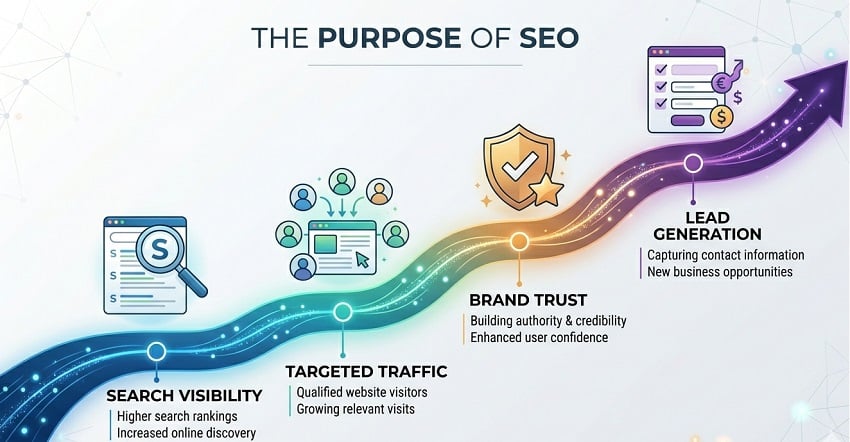
Before discussing mistakes, it helps to clarify what SEO is actually designed to do.
SEO is not simply about rankings.
Its purpose is to improve visibility for relevant searches, attract the right audience and support business growth.
That means:
- Increasing visibility in search engines
- Attracting qualified traffic
- Building trust and authority
- Generating enquiries and sales
A successful SEO strategy does not just bring more visitors.
It brings the right visitors and guides them toward action.
This distinction matters because many SEO mistakes happen when businesses focus only on traffic or rankings without considering outcomes.
SEO should support commercial goals, not vanity metrics.
Common SEO Mistakes UK Businesses Make
1. Targeting the Wrong Keywords
This is one of the most common SEO mistakes.
Businesses often target keywords based on search volume rather than relevance.
As a result, they attract traffic that has little connection to their actual services.
For example, a business may rank for broad informational searches that generate visitors but no enquiries.
Traffic increases, but conversions do not.
This creates the illusion that SEO is working when commercially it is not.
Effective SEO focuses on search intent.
The goal is not simply to attract visitors. It is to attract people likely to become customers.
2. Ignoring Technical SEO
Technical SEO is often overlooked because it is less visible.
Businesses focus on content or keywords while ignoring problems within the website itself.
Slow loading speeds, indexing issues, broken pages and poor site structure all reduce SEO performance.
Search engines struggle to crawl inefficient websites properly.
Users also leave quickly when websites perform poorly.
Technical SEO creates the foundation that allows everything else to work effectively.
3. Weak Website Content
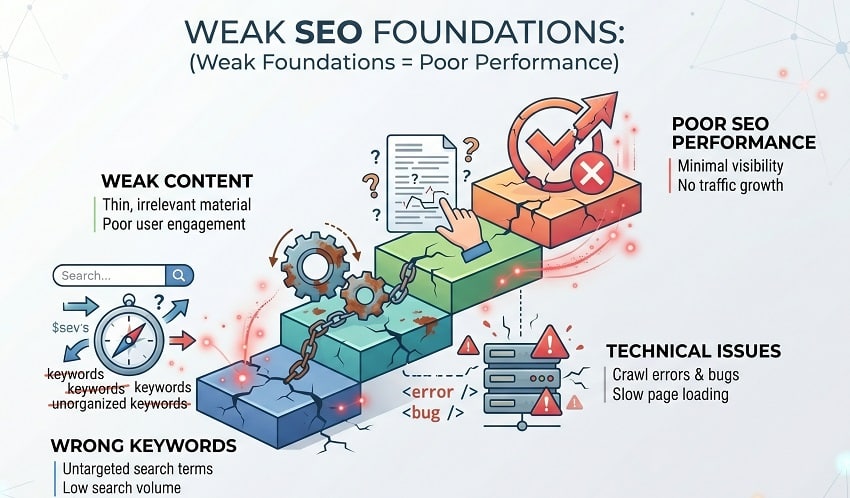
Many websites contain content that is too thin, generic or repetitive.
Pages explain very little, provide no unique value and fail to answer user intent properly.
Search engines increasingly prioritise useful, high quality content.
Weak content limits visibility and reduces trust.
It also affects conversions.
Even if users arrive on the website, poor messaging often prevents them from taking action.
4. No Clear SEO Strategy
This is where many businesses lose direction.
SEO activity happens, but there is no overarching strategy.
Blogs are published randomly. Keywords are chosen inconsistently. Changes are made reactively.
Without strategy, SEO becomes fragmented.
Businesses often waste time on low impact tasks while ignoring larger opportunities.
A strong SEO strategy defines:
- What the business wants to rank for
- Who the target audience is
- What content should be prioritised
- How progress will be measured
Without this clarity, results become inconsistent.
5. Poor Mobile Experience
Mobile usability is now critical for both rankings and conversions.
Yet many UK business websites still provide weak mobile experiences.
Pages load slowly. Navigation feels awkward. Forms are difficult to complete.
This creates friction for users and reduces engagement.
Search engines also evaluate mobile performance when determining rankings.
A poor mobile experience damages both visibility and conversion potential simultaneously.
6. Ignoring Local SEO
For businesses targeting local customers, local SEO is essential.
Yet many companies fail to optimise properly for local searches.
This often includes:
- Weak Google Business profiles
- No location targeting
- Inconsistent contact information
- Limited local content
As a result, businesses struggle to appear in local searches even when potential customers are nearby.
For Scottish and UK businesses operating within specific regions, local SEO can significantly influence lead generation.
7. Chasing Shortcuts
This is one of the most damaging SEO mistakes.
Some businesses pursue quick wins through cheap backlinks, automated tactics or outdated SEO practices.
These approaches may create short term movement, but they rarely deliver sustainable results.
In some cases, they create long term damage.
Search engines increasingly reward quality and relevance.
Shortcuts usually ignore both.
Sustainable SEO takes longer, but it creates stronger and more stable growth.
8. Weak Internal Linking
Internal linking is often underestimated.
Many websites contain disconnected pages with little logical structure.
This creates problems for both users and search engines.
Search engines use internal links to understand relationships between pages and distribute authority across the website.
Users rely on them for navigation and discovery.
Weak internal linking reduces crawl efficiency and limits SEO performance.
9. Not Tracking Conversions
Some businesses focus entirely on rankings and traffic.
But visibility alone does not measure success.
If traffic increases but enquiries do not, something is missing.
Tracking conversions is essential.
Businesses need to understand:
- Which pages generate enquiries
- Which keywords drive valuable traffic
- Where users drop off
Without this insight, SEO decisions become guesswork.
10. Expecting Instant Results
This is one of the most common causes of frustration.
Businesses expect SEO to work immediately.
When rankings do not improve quickly, they assume the strategy is failing.
SEO is a long term process.
Authority builds gradually. Content takes time to rank. Competition influences speed.
Unrealistic expectations often lead businesses to abandon effective strategies too early.
Why These SEO Mistakes Are So Common
Most SEO mistakes are not intentional.
They happen because SEO is often misunderstood.
DIY SEO plays a major role.
Business owners try to manage SEO themselves while balancing everything else involved in running a company.
Cheap SEO services also contribute to the problem.
Low cost providers often focus on quantity over quality, prioritising activity instead of strategy.
Lack of understanding is another factor.
SEO contains technical terminology that can make businesses focus on the wrong priorities.
Some businesses also become obsessed with rankings alone.
Visibility matters, but if the website experience is weak, rankings alone do not generate results.
Finally, many companies ignore website quality completely.
SEO and website performance are closely connected. Poor user experience weakens SEO outcomes.
How These Mistakes Affect Business Growth
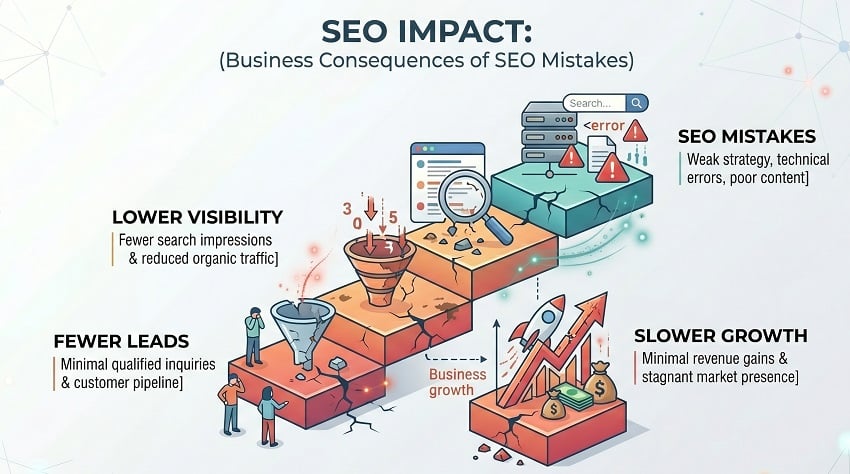
SEO problems do not only affect rankings.
They directly impact business performance.
Lower visibility reduces the number of potential customers discovering the business.
Poor targeting attracts irrelevant traffic that rarely converts.
Weak website structure reduces enquiries even when traffic increases.
Marketing budgets become less effective because traffic is wasted.
Over time, competitors who invest strategically in SEO gain stronger visibility and market share.
These effects compound gradually.
Businesses often do not notice the scale of the problem until growth has stalled significantly.
How to Fix SEO Mistakes Properly
Fixing SEO problems starts with structure and clarity. The first step is building a clear strategy.
This means understanding audience intent, defining priorities and aligning SEO with business goals.
Website structure should then be improved.
Navigation, internal linking and technical foundations all need to support search visibility and usability.
User experience must also be prioritised. A fast, clear and mobile friendly website improves both rankings and conversions.
Content should focus on value rather than volume.
Useful, well structured content performs far better long term than generic pages created purely for keywords.
Tracking meaningful results is also essential.
Businesses should measure leads, conversions and engagement, not just rankings or traffic.
How Design Hero Approaches SEO Differently
Design Hero approaches SEO strategically rather than reactively.
The process begins with understanding the business properly.
Goals, audience behaviour and website performance are analysed before optimisation begins.
SEO is aligned closely with website structure and user experience.
This ensures that visibility improvements translate into meaningful business outcomes.
Communication is transparent throughout the process.
Reporting focuses on progress and impact rather than vanity metrics.
The strategy is long term.
Instead of chasing shortcuts, the focus is on building sustainable visibility and stronger website performance over time.
Businesses also work with one point of contact, keeping communication straightforward and consistent.
For businesses across Scotland and the UK, this creates a more practical and accountable SEO process.
Want to sustainably grow your business online – Know how Design Hero Can Hero
Quick SEO Self Audit Checklist
If you are unsure whether SEO mistakes are affecting your website, this checklist can help.
- Are you targeting keywords relevant to your services
- Is your website technically stable and fast
- Does your content provide useful information
- Is your mobile experience smooth and easy to use
- Are internal links structured logically
- Are you tracking leads and conversions properly
- Do you have a defined SEO strategy
- Are you improving content consistently
- Are you avoiding shortcuts and outdated tactics
- Is your SEO aligned with business goals
If several areas are unclear or inconsistent, your SEO strategy may need refinement.
Conclusion
SEO mistakes are extremely common. ost businesses make them at some stage, particularly when SEO is managed without a clear strategy.
The good news is that these problems are usually fixable.
Once the underlying issues are identified, visibility, traffic quality and conversions can improve significantly.
The key is approaching SEO properly. That means focusing on structure, usability, strategy and long term consistency rather than shortcuts or isolated tasks.
Design Hero works with businesses across Scotland and the UK to provide SEO strategies focused on sustainable growth and measurable outcomes.
If your SEO performance feels inconsistent or your website is not generating the visibility and enquiries you expected, it may be time to review the foundations properly