

What Are Google AI Overviews?
Google AI Overviews are AI-generated summaries that appear at the top of some search results.
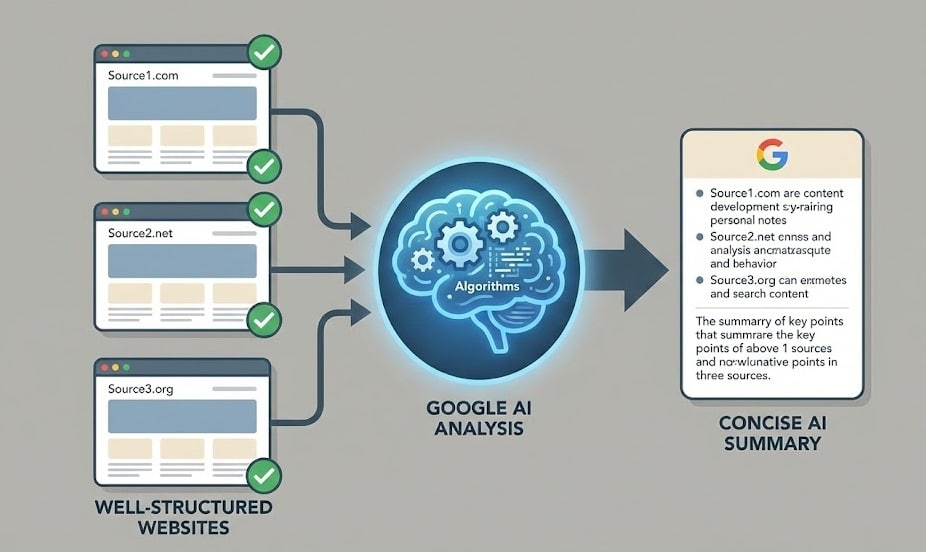
Instead of listing only links, Google now provides a direct explanation that answers a user’s question. These summaries are created by analysing content from multiple trusted websites and combining that information into a short, readable response.
This does not mean Google is inventing answers. It is selecting, summarising, and presenting information that already exists on the web.
For businesses, this changes the nature of visibility. Appearing in an AI Overview does not always mean a direct click, but it does mean authority.
It places your business as a trusted source in the user’s mind, often before they choose who to contact.
Websites that appear in AI Overviews tend to share common traits. They explain topics clearly. They answer questions directly.
They are structured logically. They demonstrate experience rather than chasing keywords.
Websites that rely on vague marketing copy or thin SEO pages are rarely selected.
Why Some Websites Appear and Others Do Not?
The difference between websites that appear in AI Overviews and those that do not is rarely budget or brand size.
It is clarity.
Google needs to understand exactly what a page is about, what question it answers, and why it should be trusted.
When a website tries to rank for too many things at once, that clarity disappears.
Topical relevance is critical. A page should focus on one subject and cover it properly.
Pages that attempt to be all things to all people are difficult for AI to summarise and therefore easy to ignore.
Structure also plays a major role. Clear headings, logical flow, and scannable sections help Google extract meaning.
Overly creative layouts, hidden text, or long unstructured blocks make interpretation harder.
Expertise matters more than ever. Google looks for signs that a business understands its subject.
This comes from depth, specificity, and consistency across related content, not from generic explanations copied from elsewhere.
Finally, consistency builds trust.
Websites that publish useful content regularly and maintain clarity across their pages send stronger signals than sites that feel outdated or neglected.
How AI Understands Website Content
AI does not browse websites like a human. It looks for structure, relationships, and signals of meaning.
Headings are one of the strongest signals.
A clear H1 tells Google what the page is about. H2 and H3 headings break the topic into understandable sections.
When headings are vague, playful, or purely stylistic, meaning is lost.
Clear answers matter. Pages that answer the main question early and directly are easier to summarise.
Long introductions that avoid the point reduce usefulness for both users and AI.
Entity clarity is also important.
Google needs to understand who you are, what services you provide, where you operate, and what topics you specialise in.
Inconsistent language or mixed messaging makes this harder.
Internal linking strengthens understanding. When related pages are clearly connected, Google can see topical depth rather than isolated information.
Design choices affect interpretation too. Clean layouts and readable HTML make content easier to extract.
Overdesigned pages that prioritise animation or visual effects over clarity often hide content from effective analysis.
Website Structure That Supports AI Overviews
1. Build topical authority, not isolated pages
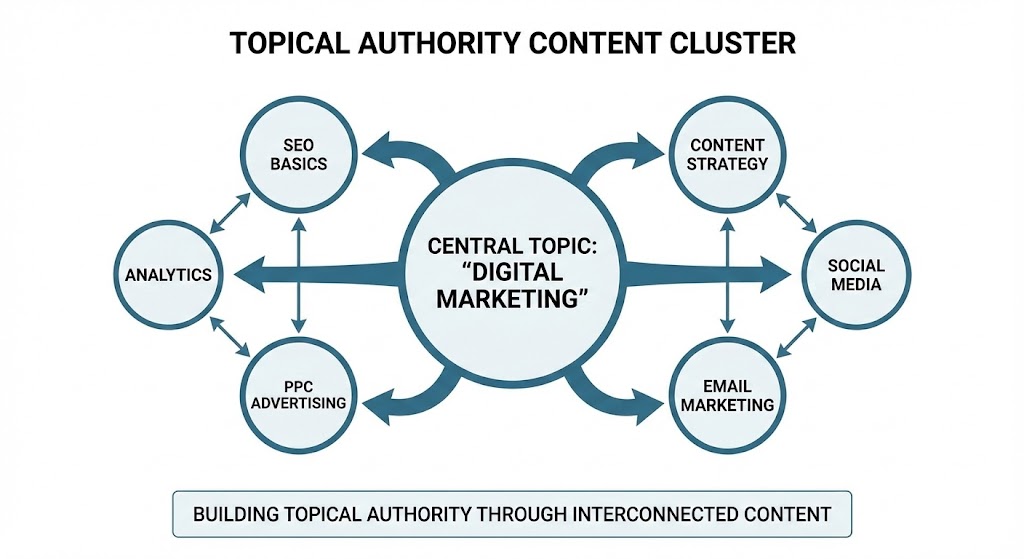
AI Overviews favour websites that demonstrate authority across a subject, not just one page.
This means covering topics fully.
Instead of one thin page on SEO, a strong website covers technical SEO, content strategy, local SEO, performance, and reporting, all linked together logically.
This approach shows Google that your business understands the topic in depth. It also improves user experience by answering related questions naturally.
Businesses that rely on single keyword pages often struggle here. AI prefers depth over breadth.
2. Give each page a clear purpose
Every page should exist for a reason.
A page that tries to rank for multiple unrelated queries usually fails to rank for any of them. It also becomes difficult for AI to summarise.
A focused page answers one question or meets one need. That clarity improves visibility and usefulness.
3. Use strong, descriptive headings
Headings should explain what follows.
A good heading could stand alone as a short answer. This helps users scan and helps AI extract meaning.
Creative headings that hide meaning may look interesting but usually perform poorly.
4. Provide concise answers early
AI Overviews often pull from early sections of a page.
This means the most important explanation should appear near the top. Supporting detail can follow later without harming depth.
This structure benefits users as well. People want quick clarity before deciding whether to read further.
5. Add depth without waffle
Depth is important, but only when it adds value.
Examples, explanations, and context strengthen authority. Repeating the same idea in different words does not.
Google recognises the difference.
Content Signals That AI Overviews Prefer
AI Overviews consistently reference content that is genuinely helpful.
Clear language performs better than clever phrasing. Simple explanations are easier to summarise and easier to trust.
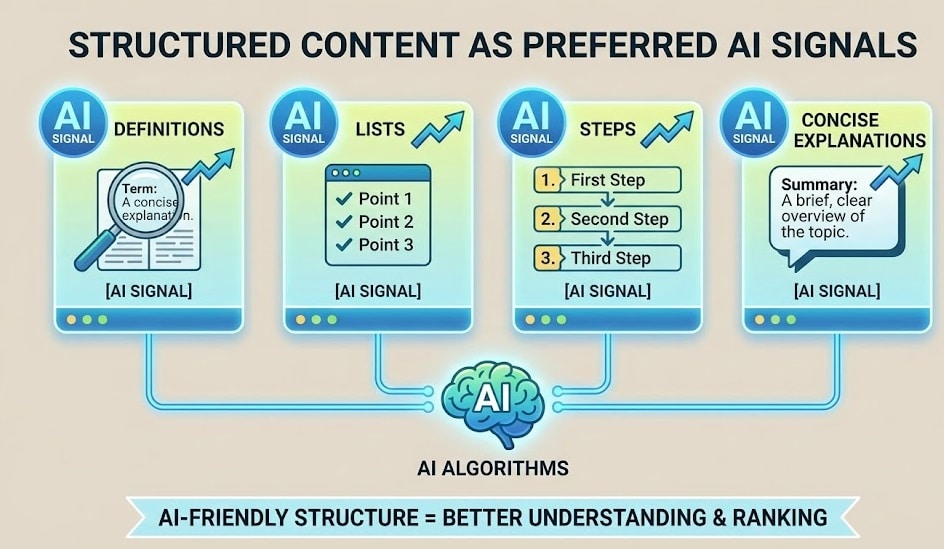
Definitions matter. Pages that explain concepts plainly are more likely to be selected than pages that assume prior knowledge.
Lists and step-by-step explanations perform well because they are structured and easy to interpret.
This does not mean every page should be a list, but clear organisation helps.
Updated information signals reliability. Content that feels current is more likely to be trusted than pages that appear outdated.
Consistency across the site also matters. When tone, terminology, and explanations align, trust increases.
AI prefers content written to educate, not content written to manipulate rankings.
Technical Foundations That Still Matter
AI search has not replaced technical SEO. It sits on top of it.
Fast loading pages improve user experience and crawl efficiency. Slow websites still lose visibility.
Mobile friendliness is essential. Most searches happen on mobile, and AI expects content to work well there.
Clean code and accessible layouts make content easier to interpret and index.
Secure websites build trust signals that still matter in AI selection.
Indexable content is non-negotiable. If Google cannot access your content properly, it cannot use it.
Ignoring fundamentals undermines everything else.
Common Mistakes That Prevent AI Visibility
Thin content remains one of the biggest problems. Pages written only to target keywords rarely offer enough value to be selected.
- Keyword stuffing actively damages clarity. AI recognises unnatural language patterns.
- Vague headings hide meaning and reduce extractability.
- Overdesigned layouts prioritise appearance over readability, often burying content behind visual elements.
- Lack of demonstrated expertise weakens trust. Generic content rarely appears in AI Overviews.
- Poor internal linking isolates pages and prevents topical authority from forming.
These issues are design and strategy problems, not algorithm problems.
How Design Hero Builds AI-Ready Websites
Design Hero approaches AI search strategically, not reactively.
Content planning comes first. Topics are chosen based on real business questions and customer intent.
Page structure is deliberate. Clear headings, focused purpose, and readable layouts are prioritised from the start.
Brand-aligned messaging ensures consistency across the site, strengthening trust signals.
SEO and UX work together. Pages are designed for people first, but structured so AI can understand them easily.
This approach produces websites that perform now and remain adaptable as search continues to change, websites built for Scottish and UK businesses.
Want to discuss how to build your new marketing strategy? contact Design Hero
What Businesses Should Do Now
The worst response to AI search is panic.
Chasing hacks or shortcuts leads to unstable results and wasted budget.
Instead, businesses should audit existing content for clarity and usefulness. Improve structure where it is weak. Remove vague language.
Focus on answering real questions well. Build authority over time rather than chasing trends.
Future-proofing a website is about intent and quality, not reacting to every update.
Conclusion
Google AI Overviews reward clarity, usefulness, and trust.
They do not replace good websites. They highlight them.
Businesses that invest in clear structure, strong content, and solid foundations will remain visible as search evolves.
If you want a website built for where search is going, not where it has been, Design Hero can help you build something ready for modern search.