

What a Website Redesign Actually Is
A website redesign focuses on how the site looks and feels rather than how it is built.
In most cases, a redesign keeps the existing foundation in place. The same CMS, structure and core functionality remain. What changes is the presentation.
A redesign might include visual updates such as new colours, fonts and imagery. Layouts are refined to feel more modern. Content may be tightened up or reorganised slightly. Calls to action are improved. Trust signals are surfaced more clearly.
Think of a redesign as redecorating a house. You are repainting the walls, updating the furniture and improving lighting, but the walls, wiring and plumbing stay the same.
When the foundation is solid, this can work very well.
Redesigns make sense when the website already performs reasonably well but looks tired or slightly out of step with the business. They are also useful when branding has evolved and the website needs to catch up visually.
A redesign is usually faster and less disruptive than a rebuild. It costs less and involves less risk when the underlying structure is sound.
The key point is this. A redesign cannot fix structural problems. It only improves what already exists.
What a Website Rebuild Actually Is
A website rebuild is a deeper, more strategic investment.
Instead of working with the existing foundation, a rebuild starts fresh. The site is rethought from the ground up, including structure, strategy, technology and performance.
A rebuild usually involves creating a new site architecture. Pages are restructured based on user journeys rather than legacy content. Messaging is rewritten to align with business goals and audience needs. The CMS may change, or the codebase may be rebuilt to improve speed, flexibility and security.
Performance issues are addressed properly. Mobile experience is prioritised. SEO foundations are reviewed and rebuilt carefully.
Using the house analogy, a rebuild is structural renovation. Walls are moved. Wiring is replaced. The layout is redesigned to suit how you actually live now, not how the house was used years ago.
Rebuilds take longer and cost more than redesigns. They also deliver bigger long term benefits when done properly.
A rebuild makes sense when the current website is holding the business back. This might be due to poor performance, outdated technology, weak conversion or a structure that no longer reflects how the business operates.
The important thing to understand is that a rebuild is not about starting over for the sake of it. It is about removing limitations that a redesign cannot solve.
Key Differences Between a Redesign and a Rebuild
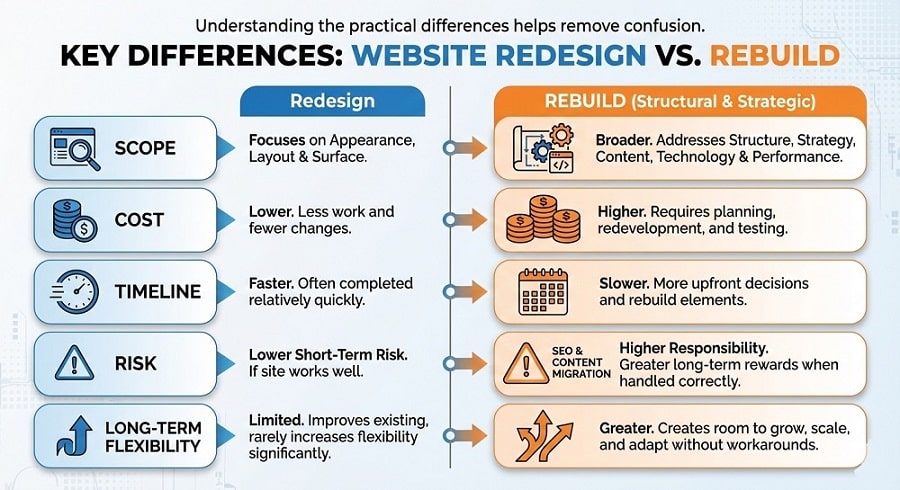
Understanding the practical differences helps remove confusion.
1. Scope
A redesign has a limited scope. It focuses on appearance, layout and surface level improvements.
A rebuild has a broader scope. It addresses structure, strategy, content, technology and performance.
2. Cost
Redesigns usually cost less because less work is involved and fewer elements change.
Rebuilds cost more because they require planning, restructuring, redevelopment and testing.
3. Timeline
A redesign can often be completed relatively quickly.
A rebuild takes longer because more decisions are made upfront and more elements are rebuilt properly.
4. Risk
Redesigns carry less short term risk when the site already works well.
Rebuilds carry more responsibility, especially around SEO and content migration, but also offer greater long term rewards when handled correctly.
5. Long term flexibility
Redesigns improve what exists but rarely increase flexibility significantly.
Rebuilds create room to grow, scale and adapt without constant workarounds.
Signs a Redesign Is Enough
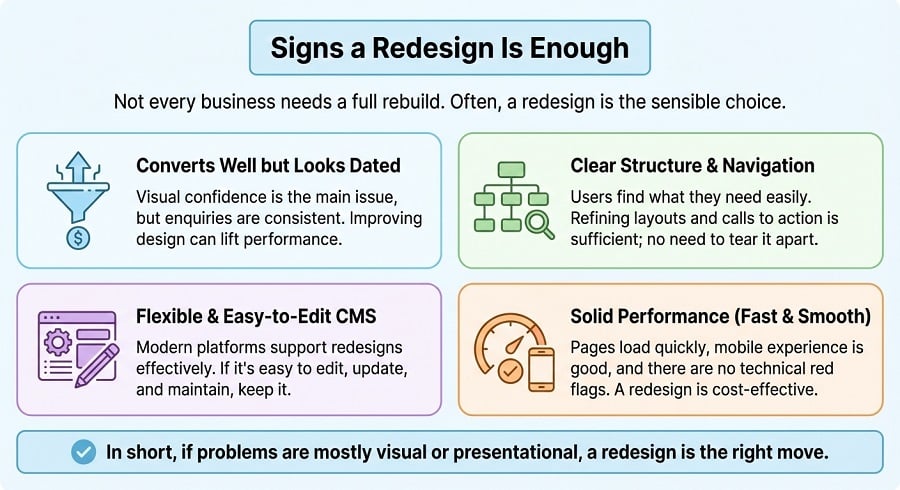
Not every business needs a full rebuild. In many cases, a redesign is the sensible choice.
A redesign is often enough when the website converts reasonably well but looks dated. If enquiries come in consistently and the main issue is visual confidence, improving the design can lift performance.
If the structure is clear and users can find what they need easily, there may be no need to tear everything apart. Refining layouts, improving calls to action and updating visuals can make a meaningful difference.
A flexible CMS is another good sign. If your website is easy to edit, update and maintain, there is less reason to rebuild. Modern platforms can support redesigns effectively when configured properly.
Solid performance also matters. If pages load quickly, mobile experience is smooth and there are no technical red flags, a redesign can be a cost effective improvement.
In short, if the problems are mostly visual or presentational, a redesign is often the right move.
Signs You Need a Full Rebuild
There are times when a redesign simply is not enough.
If your website loads slowly, especially on mobile, this is often a structural issue. Performance problems rooted in outdated code or bloated systems cannot be fixed with new colours.
Poor mobile experience is another major warning sign. If the site was not designed mobile first, redesigning the desktop layout will not solve deeper usability problems.
An outdated or restrictive CMS is a common reason for rebuilding. If simple updates are difficult, expensive or require constant developer involvement, the foundation is limiting growth.
SEO limitations also point towards a rebuild. This might include messy URL structures, duplicated content, poor internal linking or a platform that makes optimisation difficult.
Hard to edit content is a practical but important issue. If your team avoids updating the website because it is awkward or fragile, the site will fall behind quickly.
Consistently poor conversion rates are another sign. If traffic is there but enquiries are weak despite multiple tweaks, the problem is often structural.
Finally, lack of clear structure is a red flag. If pages were added over time without strategy, the site may feel cluttered and confusing. Redesigning this without rebuilding often means polishing chaos.
Cost and Time Considerations
Cost is often the deciding factor, but it should never be the only one.
A redesign usually costs less because it involves fewer moving parts. You are working with existing structure, content and technology. That makes it quicker to deliver and easier to budget for.
A rebuild costs more because it involves deeper work. Strategy, planning, content restructuring, development and testing all take time. You are not just improving what exists, you are replacing it with something stronger.
Where businesses get caught out is trying to use a redesign to solve rebuild problems. Cheap fixes often feel attractive in the short term, but they rarely deliver lasting results. When deeper issues remain, the site continues to underperform and the budget ends up being spent twice.
Time is another consideration. Redesigns are usually faster, but speed should not override suitability. A rushed rebuild can be just as damaging as an unnecessary one. Proper planning saves time later by preventing rework and frustration.
Budgeting properly means being honest about the scope of the problem. If the foundations are weak, investing in a rebuild often saves money over the life of the website.
SEO Considerations When Deciding
SEO is often a source of anxiety when discussing rebuilds, and understandably so.
A redesign generally has minimal impact on SEO when handled correctly. Content stays largely the same, URLs do not change and search engines see continuity.
A rebuild requires more care. Structure changes, content changes and technical changes can all affect rankings if not planned properly.
This does not mean rebuilds are bad for SEO. In fact, they often improve it in the long term. Cleaner structure, better performance and clearer content usually lead to stronger rankings over time.
The key is strategy.
Important pages should be identified and preserved. URLs should be maintained where possible, or redirected correctly when changes are necessary. Content that performs well should be protected and improved, not discarded.
SEO should be part of the decision making process, not an afterthought. When rebuilds are planned with SEO in mind, the risk is manageable and the upside is significant.
How Design Hero Helps Businesses Decide
At Design Hero, we do not start with a preference for redesigns or rebuilds. We start with questions.
What is working, what is not and what does the business need to achieve.
We review performance, structure, messaging and technology before making recommendations. Sometimes a redesign is the right choice. Other times a rebuild is the honest answer, even if it involves more work upfront.
Our approach is strategy led. We look at how the website supports the wider business, not just how it looks. This prevents short term fixes that create long term problems.
Clients work with one point of contact throughout. That means decisions are clear, communication is straightforward and advice is consistent.
There is no upselling pressure. If a redesign will achieve the goal, we say so. If a rebuild is necessary, we explain why and what it solves.
Everything is designed for Scotland and UK businesses. We understand local markets, expectations and search behaviour, and that context matters when making decisions.
Not sure whether to redesign or rebuild your website? Contact us for a free consultation
Simple Redesign vs Rebuild Decision Checklist
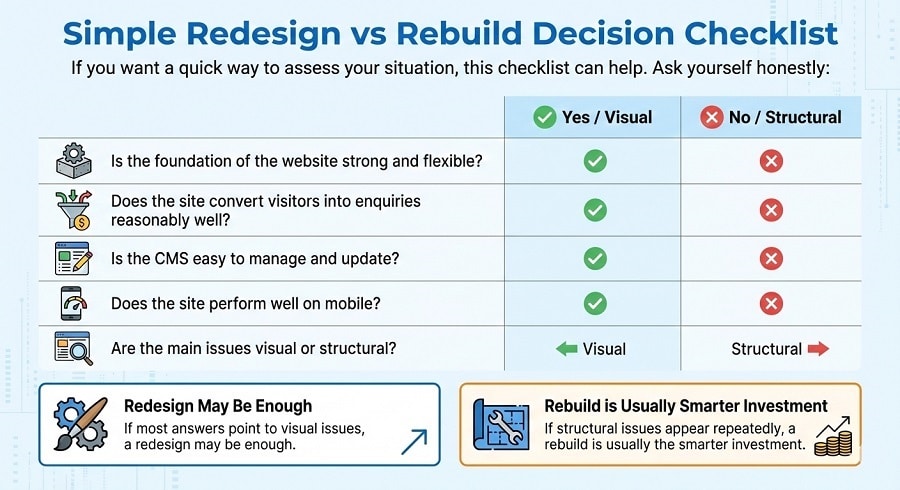
If you want a quick way to assess your situation, this checklist can help.
Ask yourself honestly:
- Is the foundation of the website strong and flexible
- Does the site convert visitors into enquiries reasonably well
- Is the CMS easy to manage and update
- Does the site perform well on mobile
- Are the main issues visual or structural
If most answers point to visual issues, a redesign may be enough.
If structural issues appear repeatedly, a rebuild is usually the smarter investment.
Conclusion
Choosing between a redesign and a rebuild is not about preference or trends. It is about suitability.
A redesign can be a smart, cost effective improvement when the foundation is solid. A rebuild is the right choice when the website is limiting growth or performance.
The wrong decision wastes the budget and creates frustration. The right decision saves time, money and stress.
If you are unsure which option fits your situation, it is worth stepping back before committing. An honest assessment now prevents expensive mistakes later.
Design Hero helps businesses across Scotland and the UK make informed decisions about their websites. If you want clear, practical guidance on whether to redesign or rebuild, we are always happy to talk it through.