

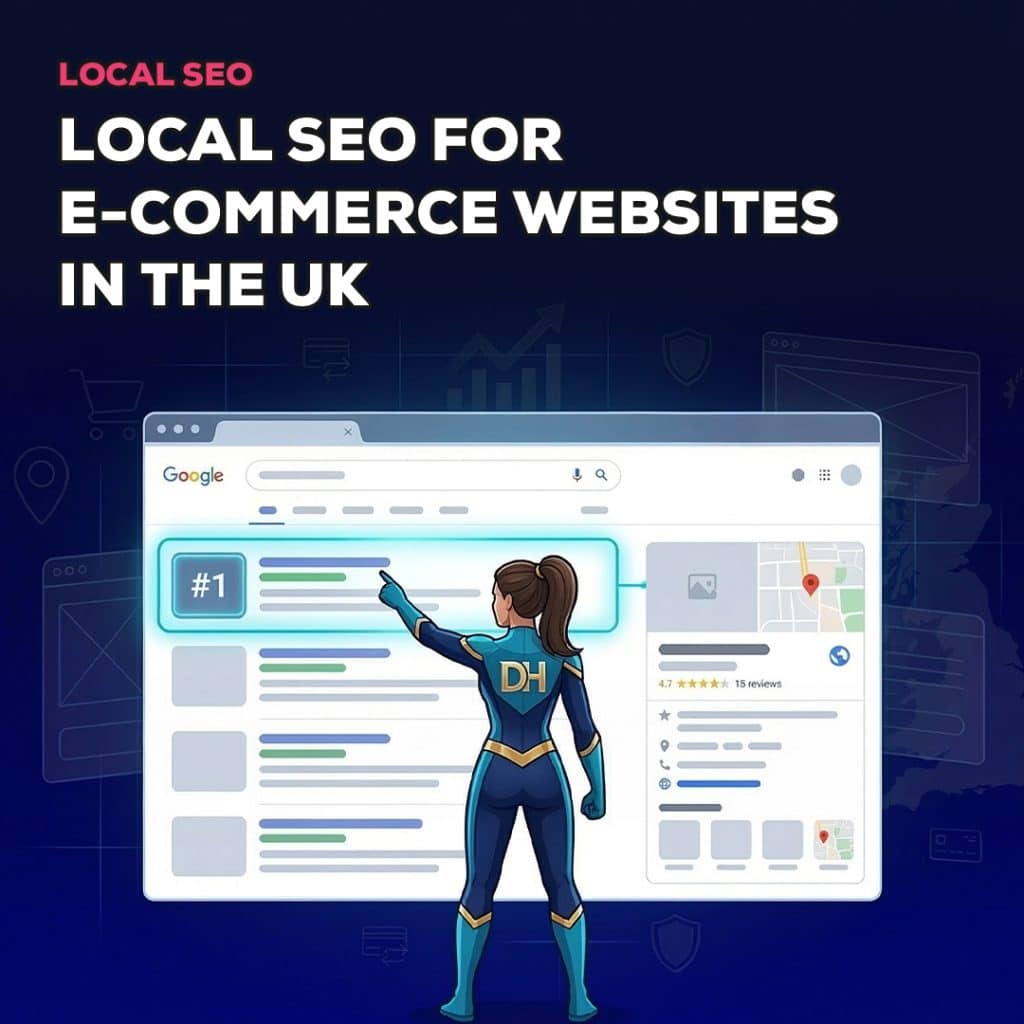
What Local SEO Means for Ecommerce Websites
Local SEO for ecommerce is not the same as local SEO for service businesses, but the principles still apply.
At its core, local SEO helps search engines understand where your business is based, who you serve and how relevant you are to users in specific locations.
For ecommerce websites, this information supports trust and authority rather than replacing traditional product based SEO.
Local SEO contributes to ecommerce in several important ways.
- First, it strengthens location signals. Even if you sell across the UK, Google still wants to understand where your business operates from. A clearly defined location helps establish legitimacy.
- Second, it builds trust. UK customers are more likely to buy from an ecommerce brand that feels grounded and accountable rather than anonymous.
- Third, it supports branded and navigational searches. When people search for your brand name plus a location, local SEO ensures you control what they see.
- Finally, local SEO complements national SEO. Strong local signals often improve overall domain trust, which benefits rankings beyond local searches.
Local SEO for ecommerce is not about limiting reach. It is about reinforcing credibility.
When Local SEO Matters for Ecommerce Businesses
Not every ecommerce business needs the same level of local SEO investment, but many benefit from it more than they realise.
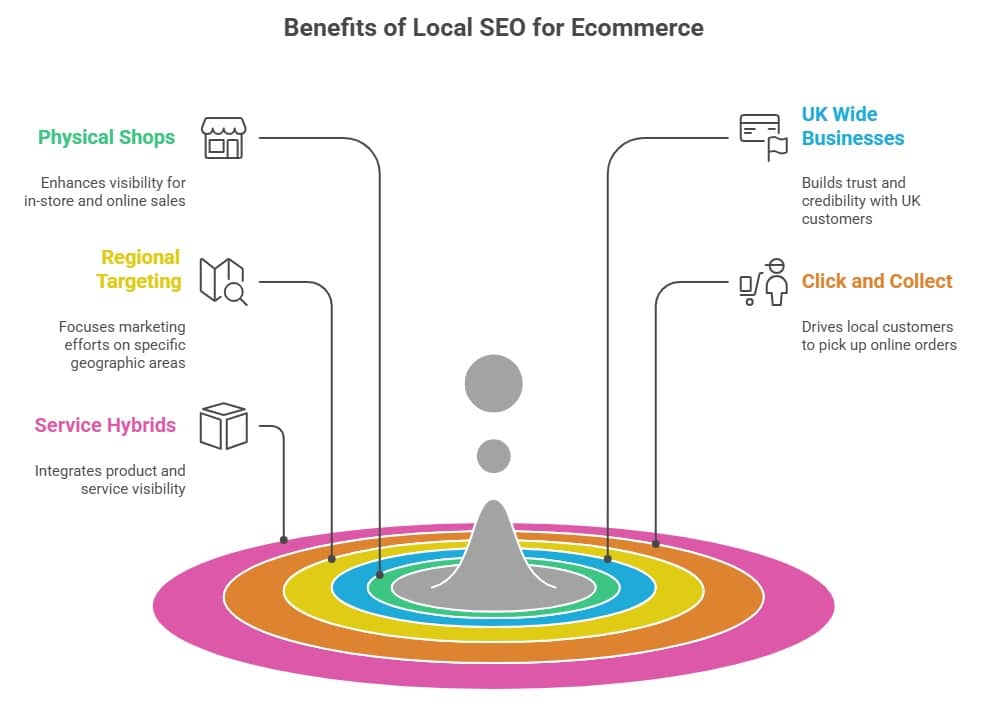
1. Ecommerce brands with physical shops
If you have a physical retail location and sell online, local SEO is essential; Customers often search for your brand or products locally before visiting or ordering online.
A well optimised local presence supports click and collect, in store visits and online sales from nearby customers.
Ignoring local SEO in this situation means leaving easy visibility on the table.
2. UK wide ecommerce businesses
Even ecommerce brands that ship nationwide benefit from local SEO.
Being clearly UK based improves trust. Customers want reassurance around delivery times, returns, customer support and consumer protection.
Local signals help reinforce that you operate within the UK market.
This is particularly important when competing with international sellers.
3. Regional targeting
Some ecommerce businesses focus on specific regions rather than the whole country. This might include:
- Scotland only brands
- England wide retailers
- Region specific product ranges
Local SEO allows you to align content and visibility with those regions without diluting relevance.
4. Click and collect models
Click and collect relies heavily on local search behaviour. Customers search locally to confirm availability, location and convenience. Without strong local SEO foundations, these opportunities are easily missed.
5. Service based ecommerce hybrids
Some ecommerce businesses sell products alongside services, installations or consultations. In these cases, local SEO becomes even more important. It helps bridge the gap between ecommerce and service visibility.
Google still cares about location because your users do.
Core Local SEO Foundations for UK Ecommerce
Before thinking about tactics, ecommerce businesses need to get the foundations right. These elements are non-negotiable.
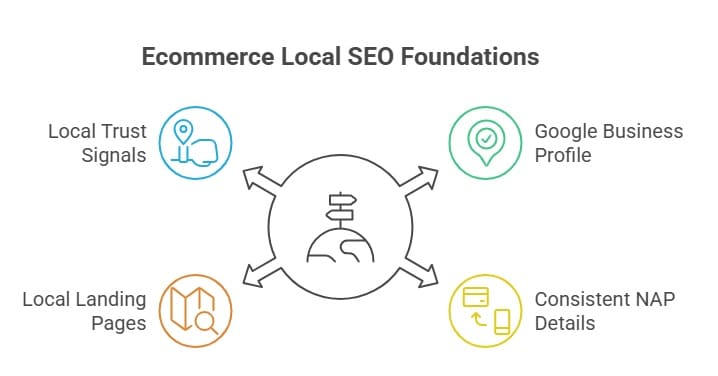
1. Google Business Profile
Many ecommerce businesses ignore Google Business Profile because they assume it does not apply to them. In reality, Google Business Profile plays a key role in visibility, trust and brand authority.
Even if you do not rely on foot traffic, a verified profile confirms that your business exists at a real location. It supports branded searches, review visibility and local trust signals.
A well maintained profile includes:
- Accurate business name
- Correct address
- Active phone number
- Website link
- Opening hours where relevant
For ecommerce brands with physical locations, this is essential. For online only brands, it still adds credibility.
2. Consistent NAP details
“NAP” stands for name, address and phone number.
Consistency matters more than volume. Your business details should be identical across your website, Google Business Profile, directories and social platforms.
Inconsistencies confuse search engines and users alike. They weaken trust signals and can harm local visibility.
For UK ecommerce businesses, consistency across UK specific platforms is especially important.
3. Local landing pages
Local landing pages help ecommerce brands target specific regions or cities in a useful way.
These pages should add value. They are not about copying product pages and swapping city names.
Good local pages might include:
- Delivery information for that area
- Region specific collections
- Local FAQs
- Store location details where relevant
Thin or duplicated pages damage credibility and rankings.
4. Local trust signals
Local trust signals reinforce relevance.
These include:
- Reviews mentioning locations
- Testimonials from local customers
- References to regional partnerships or events
Local proof supports both SEO and conversion.
On Site Local SEO for Ecommerce Websites
Local SEO is not limited to external profiles. On site optimisation plays a major role.
1. Location references in copy
Your website copy should naturally reference your location where relevant. This might appear on:
- About pages
- Contact pages
- Delivery and returns pages
Avoid forcing locations into every product description. Relevance matters more than repetition.
2. Local schema markup
Schema markup helps search engines understand your business information. For ecommerce websites, local business schema can support visibility and trust, especially when combined with clear contact and location details.
This is a technical implementation, but it supports the foundations of local SEO we have already discussed.
3. Optimised title tags
Title tags can reinforce location relevance when appropriate. This is most effective for:
- Brand pages
- Location pages
- Contact pages
Avoid stuffing locations into every title. Precision works better than volume.
4. Clear contact and location pages
A strong contact page is a trust signal and an SEO asset. It should clearly show:
- Address
- Phone number
- Map where relevant
This reassures users and supports local relevance.
5. Internal linking to local pages
Internal links help search engines understand page importance. Linking from core pages to location focused pages reinforces relevance and improves discoverability. This also supports user navigation and clarity.
Content Strategies That Support Local Ecommerce SEO
Content plays a bigger role in local ecommerce SEO than most businesses realise. It is not about adding city names to pages. It is about showing relevance, understanding and local context in a way that actually helps customers.
When content is useful, local SEO benefits follow naturally.
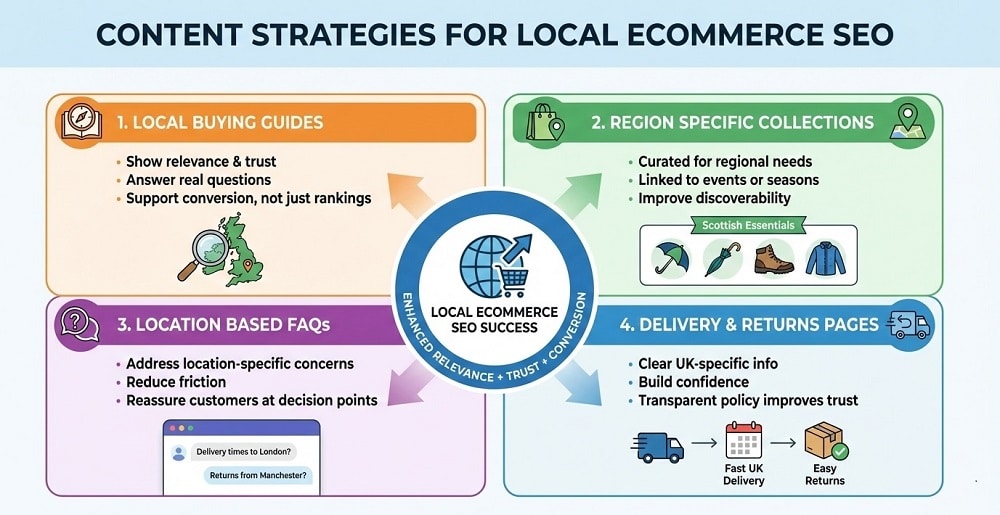
1. Local buying guides
Buying guides are a strong way to combine ecommerce, local relevance and trust. For UK ecommerce brands, this might include guides that explain which products suit certain climates, lifestyles or regional needs.
These guides help customers make better decisions while reinforcing that the business understands the local market.
A good buying guide answers real questions, reduces hesitation and supports conversion, not just rankings.
2. Region specific collections
Region specific collections work well when there is a genuine reason for them to exist.
This could be collections tailored to Scottish customers, city based themes or products linked to regional events or seasons. The key is intent. Collections should feel curated, not forced.
When done properly, these pages improve discoverability and give customers a sense that the brand feels relevant rather than generic.
3. Location based FAQs
FAQs are an easy way to support local ecommerce SEO without overcomplicating things.
Common questions often vary by location. Delivery times, returns, availability and customer support expectations can all differ across the UK. Addressing these clearly reduces friction and builds trust.
Location based FAQs also help reassure customers at key decision points.
4. Delivery and returns pages with local clarity
Delivery and returns pages are some of the most visited pages on an ecommerce site, yet they are often vague. Clear UK specific delivery information builds confidence.
Customers want to know how long delivery takes, where items ship from and what happens if something goes wrong. Being transparent here improves both trust and conversion.
These pages also reinforce that the business operates within the UK market.
5. Local blog content when relevant
Blog content can support local ecommerce SEO when it is tied to real activity. This might include posts about local pop up shops, partnerships, events or behind the scenes stories that connect the brand to a place.
The goal is not volume, but relevance. Local blog content works best when it adds context and personality rather than chasing keywords.
Reviews and Reputation for Ecommerce Brands
Reviews influence both local SEO and conversions:
For ecommerce businesses, reviews do more than reassure buyers. They also send strong trust signals to search engines, particularly when linked to a Google Business Profile or reputable third party platforms.
Google reviews play a central role here. Even ecommerce brands without heavy foot traffic benefit from having an active review profile; This reinforces legitimacy and improves visibility for branded and local searches.
Product reviews matter too!
Displaying reviews directly on product and category pages helps users make decisions faster. It also increases the amount of unique, relevant content on key pages.
Where possible, encourage reviews that include context. Reviews mentioning delivery experience, location or customer support often feel more credible and useful than generic praise.
Fake or manipulated reviews damage trust quickly. UK consumers are increasingly aware of review fraud, and search engines are better at detecting it too. Authenticity always wins in the long term.
Common Local SEO Mistakes Ecommerce Businesses Make
Many ecommerce businesses invest in SEO but overlook local fundamentals. These mistakes often limit performance without being obvious.
- One common issue is ignoring Google Business Profile entirely. Even online focused brands benefit from a verified and well maintained profile. Leaving it unclaimed or incomplete is a missed opportunity.
- Another mistake is creating duplicate location pages with minimal changes. Simply swapping city names without adding value does not work. It weakens credibility and can harm rankings.
- Keyword stuffing is still a problem with Local SEO: Forcing city names into product titles, descriptions or footers makes content feel unnatural and untrustworthy. Google and users both recognise this.
- Lack of local trust signals is another frequent issue. No reviews, no testimonials, no regional proof. This makes ecommerce brands feel distant and anonymous.
- Finally, poor mobile experience undermines everything else. Local searches are often mobile. If the site loads slowly or is hard to use on a phone, visibility and conversions both suffer.
- Avoiding these common pitfalls is a priority for digital growth experts worldwide, with many seo companies Pittsburgh highlighting that a verified Google Business Profile is often the ‘make or break’ factor for any online store’s legitimacy
How Local SEO Supports Ecommerce Conversions?
Local SEO is not just about rankings. It directly affects conversion behaviour;
When users see clear location signals, trust increases. They feel reassured that the business is real, accessible and accountable. This trust leads to higher click through rates from search results. Users are more likely to choose a result that feels relevant and familiar.
Local relevance also attracts better qualified traffic. Visitors arriving through local or branded searches often have stronger intent and higher conversion potential.
Over time, consistent local visibility strengthens brand recognition. When customers see your brand repeatedly in local contexts, confidence grows and hesitation decreases.
Local SEO supports ecommerce by reducing uncertainty, not by limiting reach.
How Design Hero Approaches Local SEO for Ecommerce
Local SEO for ecommerce only works when it is aligned with the wider strategy. Treating it as a bolt on rarely delivers meaningful results.
At Design Hero, we start with context. We look at how the ecommerce business actually operates, where customers are based, how products are delivered and what role location plays in the buying decision.
This shapes everything that follows:
Strategy comes first. Before touching keywords or tools, we define where local relevance matters and where it does not. Some ecommerce brands need strong city or regional visibility.
Others benefit more from reinforcing UK wide credibility. The approach changes depending on the business model.
We then align ecommerce SEO and local SEO so they support each other. Product pages, category structure and content strategy are designed to work alongside location signals rather than compete with them. This avoids diluted relevance and confused messaging.
Conversion is always part of the conversation. There is no point driving local traffic if the website does not feel trustworthy or easy to use. Local SEO works best when combined with clear messaging, strong trust signals and a smooth buying journey.
Communication is kept simple throughout. Our clients deal with one point of contact who understands ecommerce, SEO and web design. No jargon. No vague reporting. Just clear explanations and practical decisions.
Most importantly, everything is designed for UK and Scottish businesses. We understand how UK customers search, what builds trust and how local context affects conversion.
Want to know how to grow your local business with SEO – Contact Design Hero
Quick Local SEO Checklist for Ecommerce Websites
Use this checklist to audit your ecommerce website honestly. If several boxes are not ticked, there is likely an untapped opportunity.
- Google Business Profile is claimed, verified and up to date
- Business name, address and phone number are consistent everywhere
- Contact and location information is clear on the website
- Local or regional pages add genuine value
- Reviews are visible and authentic
- Delivery and returns information is clear for UK customers
- Mobile experience is fast and easy to use
- Location signals support trust rather than feel forced
This checklist is not about perfection. It is about clarity and consistency.
Conclusion
Local SEO is not just for big businesses, trades and high street shops. In the UK, location still plays a role in how ecommerce brands are discovered, trusted and chosen.
For online stores, local SEO supports credibility, improves branded visibility and strengthens conversion. It helps customers feel confident that they are buying from a real, reliable business.
Many ecommerce brands overlook this because they assume selling online removes the need for local relevance. In reality, it makes trust even more important.
If your ecommerce website is investing in SEO but results feel unclear, it is worth reviewing how local signals are being handled. Small changes can have a big impact when they are aligned with the right strategy.
Design Hero helps ecommerce businesses across the UK and Scotland bring together search, location and conversion. If you want honest advice on how local SEO fits your ecommerce strategy, we are always happy to have a straightforward conversation.