


Why the Choice of Platform Matters for Raffle Websites
Most people think platform choice is a technical decision. In reality it is a business decision.
A raffle website is not a typical blog or ecommerce store. It needs to handle:
- Frequent traffic spikes during promotions and draw days
- Secure payment flows that uphold user trust
- Clear display of competition rules, odds, and terms
- Fast mobile and desktop performance
- Integration with marketing and SEO features
Pick the wrong platform and none of this works as effectively as it should. It will feel slow, unreliable, and leave users doubting your professionalism.
This ties back into the trust and conversion issues we cover in 3 reasons raffle sites fail.
What Makes a Platform “Good” for Raffle Websites?
Before we list the options, let’s be clear on what matters for raffle platforms.
A good platform should support:
1. Performance and Speed Slow websites lose entries. Fast platforms load quickly on both desktop and mobile.
2. Security and Compliance Handling payments and personal data requires a secure platform that supports SSL, secure checkout, and good hosting compatibility, in line with the PCI Security Standards Council’s requirements for any site processing card payments.
3. Scalability Traffic spikes are expected during promotions and draws. Your platform must cope without crashing, a topic we go into in full in hosting for competition and raffle websites.
4. Customisation and Flexibility You need control over design, pricing, ticket bundles, and user flows.
5. SEO and Content Power Platforms that support structured content help you rank for educational and transactional keywords, which supports the strategies covered in our SEO for raffle websites guide.
6. Ease of Use Not just for admins, but for entrants: clear layouts, friction free flow, accessible odds and rules.
Platforms that excel in most of these areas are the ones that support long term growth rather than short term launches.
The Best Platforms for Raffle Websites (UK Focus)
Below we review each platform category objectively, with strengths, limitations, realistic cost ranges, and when to choose each.
Platform Option 1: Custom CMS with WordPress and Custom Plugins
Best for: long term growth, full control, SEO authority, unique design
WordPress is not a raffle platform out of the box, but with the right configuration it can be one of the most powerful bases for a competition website.
Strengths
- Complete control over design and UX
- Mature ecosystem of plugins and tools
- Excellent SEO capability
- Easy integration with analytics, CRM, email marketing
- Scalable with proper hosting
Limitations
- Requires technical setup
- Must integrate ticketing and payment features
- Needs good hosting to perform well
Realistic cost range A properly built WordPress raffle site typically costs somewhere between £3,000 and £15,000 to build, depending on how custom the ticketing logic, skill question flow, and design need to be, plus ongoing hosting from roughly £20 to £150 a month for infrastructure sized correctly for draw day traffic spikes, covered in more depth in how to choose a payment gateway provider for online competition sites. Unlike a revenue share model, these are largely fixed costs, so profitability improves as ticket volume grows rather than being eaten into by a percentage fee on every sale.
For UK raffle sites that want longevity and content authority, WordPress is often the best starting point, especially when paired with a reliable hosting setup and the right customisations.
Design Tip: Keep Checkout Flow Clean When building entry pages on WordPress, ensure:
- Ticket pricing is visible early
- Bundle options are clear
- No unnecessary popups between selection and checkout

This supports conversions and trust.
Why We Recommend It: WordPress enables you to build content that supports SEO and user education, essential for long term traffic.
Platform Option 2: Headless CMS with Jamstack or Static Site Frameworks
Best for: ultra fast performance, mobile optimisation, high traffic promotions
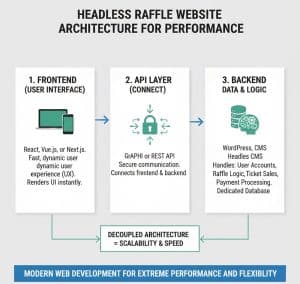
Headless platforms, such as Gatsby or Next.js, combined with a content API, allow for very fast, secure, and scalable sites.
Strengths
- Incredible performance and speed
- Strong SEO foundations
- Excellent mobile user experience
- Easy integration with modern APIs
Limitations
- Requires specialised development
- Not as friendly for non-technical editors
- Must integrate payment and dynamic entry features via custom code
Realistic cost range Expect £8,000 to £30,000 or more for a properly built headless raffle site, since specialist development time is the main cost driver rather than hosting, which can actually run cheaper than a traditional server setup once the site is live, often £10 to £80 a month, because static content requires far less server work to serve.
This is a top choice for high performance sites that expect spikes, for example large prize launches or national campaigns.
Design Tip: Pre-Render Static Content Use static generation for:
- Competition descriptions
- Prize galleries
- Terms and conditions
This keeps pages blazing fast and reduces server load.
When to Choose This: If speed, resilience, and SEO are your top priorities and you have access to developers who can implement modern frameworks.
Platform Option 3: Pure Ecommerce Platforms
Best for: simpler competition sites, products plus entries hybrid
General purpose ecommerce platforms can be extended with plugins or apps to sell raffle entries as products.
Strengths
- Familiar commerce workflows
- Easy payment integration
- Built in cart and checkout
- Good for hybrid experiences, product plus competition
Limitations
- Not designed for competitions natively
- Can feel generic or forced without customisation
- SEO may require extra work
Realistic cost range: Monthly platform fees for ecommerce builders typically run £20 to £300 depending on tier, before you add transaction fees on top of your payment processor’s own charges, which can quietly erode margin on a high volume raffle site in a way a fixed hosting cost does not. WordPress paired with ecommerce plugins often provides more flexibility for content and SEO than a closed ecommerce platform, for a comparable or lower ongoing cost.
A general purpose ecommerce platform works well if your raffle is part of a larger commerce site, for example a community store or charity hub.

Design Tip: Avoid Default Themes for Checkout. Default commerce templates are not built for competition psychology. Customise:
- Entry bundle displays
- Checkout messaging
- Prize visuals
This supports conversions and aligns with trust expectations.
Platform Option 4: Dedicated Competition Platforms (Custom Built)
Best for: full control, unique features, compliance requirements
Some businesses opt for a fully custom platform built from scratch. This is typically done with frameworks such as Laravel, Django, or Ruby on Rails.
Strengths
- No limitations
- Tailored data models and user flows
- Can integrate features like advanced odds calculators or live draw mechanics
- Can be built exactly with compliance expectations in mind
Limitations
- Higher upfront cost
- Requires ongoing development support
- Must solve hosting, scaling, and security in house
Realistic cost range: A fully custom build realistically starts around £20,000 and can run well past £100,000 for a platform with advanced odds engines, live draw infrastructure, and affiliate systems built in. Ongoing development retainer costs of £1,000 to £5,000 a month are common, since a bespoke platform has no vendor support line to call when something breaks.
This option works best for organisations planning to grow beyond simple lottery mechanics or those with bespoke compliance needs.
When This Makes Sense If you:
- Expect very high traffic
- Have complex competition logic
- Need advanced custom rules
- Plan to scale as a competitive platform
Platform Option 5: Hosted Competition Builder Services
Beyond self-built platforms, there is a category of hosted, subscription or fee based competition builder services that let you launch a raffle website quickly without managing hosting, ticketing logic, or payment infrastructure yourself.
Strengths
- Quick setup, often live within days
- Built in dashboards for managing draws and entrants
- Less technical overhead
- Payment processing and compliance handled by the provider
Limitations
- Limited customisation of design and checkout flow
- Hosting infrastructure is often outside the UK, which can affect speed and data handling
- SEO and content flexibility is typically restricted to what the platform allows
- Scalability is constrained by the provider’s own infrastructure and pricing tiers
Realistic cost range: These services typically charge in one of three ways: a flat monthly subscription from roughly £20 to £150, a percentage fee on ticket revenue commonly ranging from 1.5% to 5%, or a combination of both. A revenue share model can look cheap at low volume but becomes genuinely expensive once a raffle site is doing meaningful sales, since the fee scales directly with your success rather than levelling off the way a fixed hosting cost does.
These tools are fine for one-off competitions or testing an idea before committing to a custom build, but they rarely support the long term growth or SEO authority that a dedicated domain and custom platform can build over time.
Trust and Urgency Mechanics That Drive Conversions
Platform choice determines what is technically possible, but the mechanics you actually implement on top of it are what convert a hesitant visitor into a paying entrant. This is one of the most under-discussed parts of raffle website strategy, so it is worth covering properly here.
Countdown timers on every active competition create genuine urgency tied to a real closing date. These work because they give a visitor a concrete reason to act now rather than bookmark the page and forget about it.
Live percentage sold indicators show entrants how close a competition is to selling out. Seeing a bar at 85% sold does more to prompt a purchase than any amount of persuasive copy, since it signals both scarcity and social proof at the same time, other people clearly believe this is worth entering.
Visible, verifiable winner proof matters more in this category than almost any other ecommerce niche, since entrants are handing over money for an outcome that has not happened yet. A dedicated, regularly updated winners page with names, dates, and prizes won gives a sceptical visitor something concrete to check before they trust you with a payment. This is one of the clearest trust gaps we see on raffle sites that otherwise look professional, a beautifully designed site with no visible proof that anyone has ever actually won.
Live or recorded draw footage, even a simple video of the random number generator result, adds a layer of transparency that a text announcement alone cannot match. Pairing this with a clear explanation of how the draw works, covered in full in our raffle site FAQs for UK operators, closes the trust gap further.
None of these mechanics require a specific platform. They are achievable on WordPress, a headless build, or a custom platform alike, which is exactly why they belong in the design brief regardless of which option above you choose.
Key Technical Considerations When Choosing a Platform
The platform is just one part of the equation. How it is hosted, configured, and optimised matters even more.
1. Hosting
Choose infrastructure that supports:
- Fast load times
- High uptime
- Scalability
For WordPress or custom builds, we recommend VPS or cloud hosting rather than cheap shared plans. If you want to review hosting strategies in depth, see hosting for competition and raffle websites.
2. Security
Ensure SSL and secure payment flows. Platforms should support:
- PCI compliance
- Regular updates
- Web application firewalls
Security is not optional when payments are involved.
3. Mobile Performance
Most raffle entries come from mobile users. Platforms that struggle on mobile will lose revenue. You can check your own site’s real world mobile performance against Google’s benchmarks using PageSpeed Insights. If speed is a priority, headless or static approaches often perform best.
4. SEO Foundations
Content needs to be indexable, crawlable, and structured. This is essential for Google search and AI summarisation.
If you want to improve your visibility, our SEO for raffle websites guide explains the foundations.
Design Tips Based on Platform Choice
Platforms shape design possibilities. Here is how to think about design for each.
WordPress and Custom Platforms
You have total control. Use that to:
- Craft custom pricing and bundle displays
- Add trust signals like a winners section and FAQs
- Structure pages for both humans and AI
Ecommerce Platforms
Override templates to:
- Highlight draw dates
- Show odds clearly
- Avoid shop centric language that feels transactional
Headless and Static Platforms
Leverage speed to:
- Enhance animations without performance loss
- Include rich prize galleries
- Prioritise smooth entry flows
Design is not decoration. It influences trust, clarity, and conversions, which is especially important on competition sites where hesitancy is already built into the user’s mind.
Case Study Insights: What Works in the Wild
When we audit competition sites that convert consistently, they share common platform decisions.
High Converting Platforms Tend To:
- Use WordPress or custom builds with strong SEO foundations
- Prioritise performance and hosting stability
- Integrate payments cleanly
- Use content to educate users before they enter
- Display odds and rules clearly, alongside visible, verifiable winner proof
This aligns with patterns covered in our competition guide.
Conclusion: The Best Platform Depends on Your Goals
There is no one perfect platform for every situation. But the right platform for your UK raffle website is the one that supports:
- Performance you can trust
- Security and compliance clarity
- Design flexibility to educate and convert
- SEO foundations for long term visibility
- Scalability as traffic grows
For most UK competition sites aiming for growth and authority, WordPress with a customised stack or a modern headless architecture hits the balance of control, performance, and long term potential.
Hosted competition builder services and standalone ecommerce platforms can work for simpler use cases or hybrid product plus competition sites, but rarely match long term SEO and design flexibility once revenue share fees are factored in.
Custom builds make sense when you need truly bespoke logic or scale, but they come with a higher investment, both upfront and in ongoing development support.
Want the Best Platform Built for You?
At Design Hero, we specialise in building UK raffle and competition websites that balance platform choice, performance, trust, compliance and conversion not just look good.
If you want a site that actually performs when it matters most, explore:👉 Raffle Website Design service.