


Why Raffle Website Design Has an Outsized Impact on Conversions?
In most industries, a “good enough” website can survive with strong marketing behind it. Raffle websites don’t get that luxury.
If a user has even a moment of doubt about legitimacy, fairness, or clarity, they leave. There’s rarely a second chance.
That’s why we often see competition sites pouring money into ads while conversions remain stubbornly low.
Design is usually the silent culprit.
This is also why so many raffle projects stall early. The fundamentals weren’t addressed properly at the start.
We’ve outlined the most common causes in 3 reasons raffle sites fail, and poor design decisions almost always play a central role.
Good raffle design doesn’t shout. It reassures.
Trust Is the Primary Conversion Lever (Not the Prize)
It’s tempting to believe that the prize does most of the work. In reality, the prize only attracts attention. Trust is what converts.
A high-converting raffle website communicates legitimacy before it communicates excitement.
Users should feel, almost subconsciously, that the business behind the competition is real, organised, and accountable.
That comes from:
- Clean layout and spacing
- Consistent branding
- Clear ownership and company details
- Transparent language
- Professional typography and imagery
If your site feels rushed, users assume the competition is too.

Your Homepage Must Explain Everything Without Overwhelming
The homepage of a raffle website has a very specific job. It must orient the user quickly and confidently.
Before scrolling, users should understand:
- What the competition is
- What they can win
- How much it costs to enter
- What action to take next
Anything that delays this understanding creates friction.
Many raffle sites try to be clever with vague headlines, oversized sliders, or abstract messaging. The result is confusion, not curiosity. Clear, direct communication almost always outperforms creative ambiguity.
A strong homepage prioritises:
- Specific headlines
- Plain-English explanations
- One clear primary CTA
- Minimal competing actions
This clarity reduces mental effort and increases confidence, which directly impacts conversion rates.
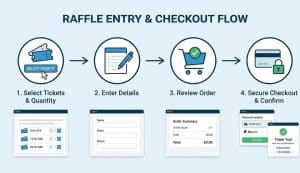
Designing an Entry Journey That Feels Predictable and Safe
Once a user decides to enter, your design has one job: don’t make them second-guess that decision.
High-converting raffle websites use predictable patterns. Users should feel like they’ve “done this before”, even if they haven’t.
That means:
- Clear ticket selection
- Obvious pricing
- No surprise fees
- Minimal form fields
- Reassuring confirmation steps
Payment is the most sensitive moment in the journey. Poorly chosen gateways, unclear messaging, or clunky UX cause drop-offs even when intent is high.
This is why payment considerations must be part of the design process, not an afterthought something we cover in how to choose a payment gateway provider for online competition sites.
Compliance Should Be Obvious, Not Buried
One of the biggest design mistakes raffle websites make is hiding compliance information in the footer and hoping users don’t notice it.
That approach backfires.
Transparent compliance actually increases trust. When users can clearly see how the competition works, when the draw happens, and what rules apply, hesitation drops.
Good design integrates compliance naturally:
- Clear links to terms and conditions
- Simple explanations of how winners are chosen
- Visible draw dates and mechanics
- Accessible free-entry information where required
If you’re unsure what needs to be communicated, our guides on raffle, competition and lottery sites and the code of good conduct for raffle sites provide essential context.
Design should support compliance, not obscure it.
Reinforcing Legitimacy as Users Scroll
First impressions matter, but sustained reassurance matters more.
As users move down the page, your design should continue to answer unspoken questions:
- Has this worked for others?
- Do people really win?
- Is this business accountable?
High-performing raffle websites reinforce legitimacy with:
- Winner showcases
- Draw explanations or recordings
- Clear “How it works” sections
- Honest FAQs that address skepticism directly
This kind of content doesn’t just improve conversion rates. It also supports long-term growth and promotion strategies, which we explore further in how to promote raffle sites.

Supporting Content That Builds Authority and Confidence
A raffle website should never rely on a single landing page.
Supporting content plays a critical role in:
- Improving SEO visibility
- Educating hesitant users
- Reducing customer support friction
- Positioning the brand as credible
Strong supporting pages include:
- Detailed “How it works” explanations
- Transparent “About” pages
- Well-written FAQs
- Educational blog content
This becomes especially important when targeting specific audiences.
Different niches respond to different messaging, expectations, and trust signals. We’ve explored this in depth in profitable raffle site niches.
Mobile Design Is Where Conversions Are Won or Lost
For most raffle websites, mobile traffic dominates. Yet mobile UX is still where many sites underperform.
High-converting mobile raffle sites:
- Load quickly on average connections
- Use large, tap-friendly buttons
- Avoid dense blocks of text
- Keep CTAs visible without being intrusive
- Make checkout effortless
If users have to pinch, zoom, or squint, conversions suffer. Desktop polish cannot compensate for poor mobile experience.
Image Strategy: Purpose Over Decoration
Images should never exist just to fill space.
On raffle websites, strong images:
- Show the actual prize clearly
- Explain processes visually
- Reinforce trust and transparency
- Break up long sections thoughtfully
Every image should:
- Be high quality
- Use a descriptive filename
SEO and Structure Must Be Considered From the Start
Design and SEO are not separate disciplines for raffle websites. They support each other.
Well-structured pages with clear headings, fast load times, and logical internal linking perform better both for users and search engines.
If you’re building a raffle business for the long term, SEO needs to be part of the design conversation early.
Our competition business guide explains how design, content, and growth strategy connect.
Conclusion: Design Is What Turns Interest Into Entries
A successful raffle website doesn’t rely on hype, aggressive marketing, or unrealistic promises. It relies on clarity, trust, and a design that quietly does its job at every stage of the user journey.
When design is done properly, users don’t feel pushed into entering. They feel comfortable doing so. They understand how the competition works, believe it’s fair, and trust the business running it.
That confidence is what turns casual interest into paid entries and one-off visitors into repeat customers.
If there’s one takeaway from this guide, it’s this: raffle website design isn’t about looking impressive it’s about removing doubt.
Every layout choice, page structure, image, and line of copy should make the decision to enter feel easier, safer, and more obvious.
Get that right, and everything else from marketing to scaling becomes significantly more effective.
Need a Raffle Website Built to Convert?
At Design Hero, we design raffle websites that prioritise trust, compliance, and real-world performance, not generic templates that look good but underdeliver.
If you’re serious about launching or improving a competition platform, explore our Raffle Website Design service and see how we help raffle brands do things properly from day one.
Frequently Asked Questions
What makes a raffle website high-converting?
A high-converting raffle website is built around trust and simplicity. Clear messaging, transparent pricing, predictable entry flows, visible compliance information, and strong mobile performance all work together to reduce hesitation and increase entries.
Do raffle websites need to look different from normal eCommerce sites?
Yes. While there are similarities, raffle websites require additional trust signals, clearer explanations of how draws work, and visible fairness and compliance elements. Users are buying a chance, not a product, which changes how decisions are made.
How important is compliance in raffle website design?
Compliance is critical. Clear terms, draw mechanics, and fair-play information should be easy to find and understand. Well-designed compliance content increases trust and protects both the user and the business in the long run.
Should raffle websites be designed mobile-first?
Absolutely. Most raffle traffic comes from mobile devices. If the mobile experience is slow, confusing, or difficult to use, conversions will suffer regardless of how good the desktop version looks.