

This problem is everywhere.
People land on your website.
They scroll a bit.
Then they leave.
No enquiry.
No call.
No booking.
Business owners across Scotland tell us the same story.
The homepage looks good.
It feels modern.
But it does nothing.
That is because most homepages are designed to impress, not to guide.
A homepage is not a piece of art.
It is not a brochure.
It is not a dumping ground for everything your business does.
A homepage is a decision making tool.
Its job is simple.
Help the right person understand what you do, trust you, and take the next step.
When a homepage fails, the rest of the website never gets a chance.
This article explains how high converting homepages actually work.
No trends.
No fluff.
Just structure, clarity and purpose.
What a Homepage Is Meant to Do?
Before talking about design, we need to reset expectations.
A homepage has four jobs.
Nothing more.
Communicate what you do
Visitors should understand your business within seconds.
Not minutes.
Not after scrolling.
Not after clicking three pages.
If users cannot tell what you do quickly, they leave.
Show who you help
A good homepage makes the right people feel like they are in the right place.
It speaks directly to their situation.
It uses language they recognise.
If everyone feels like your customer, no one is.
Build trust fast
Most visitors are cautious.
They are comparing options.
They are judging credibility.
They are looking for signs that you are real and reliable.
Trust must be established early.
Guide users to the next step
A homepage should never be passive.
It should guide users somewhere logical.
Contact.
Services.
Booking.
Proof.
If users are left to decide what to do, they usually do nothing.
The Key Elements of a Homepage That Converts
High converting homepages are not complex.
They are intentional.
Below are the elements that matter most.
1. Clear headline and value proposition
This is the most important part of the homepage.
Why it matters
Users decide whether to stay in seconds.
Your headline carries the weight of that decision.
What it should do
It should clearly explain:
- What you do
- Who it is for
- Why it matters
Common mistakes
- Vague slogans
- Buzzwords
- Clever but unclear wording
What works instead
Plain language.
Clear outcomes.
Confidence without hype.
If a stranger cannot understand your headline, it is not working.
2. Strong hero section
The hero section sets the tone for the entire site.
What it includes
- Clear headline
- Short supporting statement
- Primary call to action
Why it matters
This is where users decide whether to engage or leave.
A strong hero section creates momentum.
What to avoid
- Huge images with no message
- Multiple competing calls to action
- Sliders that hide key information
The hero section should lead, not distract.
3. Immediate trust signals
Trust should not be buried.
Why it matters
Users do not assume credibility.
They look for proof.
What works
- Short testimonials
- Client logos
- Reviews
- Accreditations
Where they belong
Near the top of the homepage.
Close to the hero section.
Trust early reduces resistance later.
4. Clear navigation
Navigation should feel effortless.
Why it matters
Confusion kills conversions.
If users cannot find what they want quickly, they leave.
What works
- Simple menu
- Clear labels
- Limited options
What to avoid
- Too many pages
- Clever names that mean nothing
- Deep dropdowns
Navigation should guide, not overwhelm.
5. Benefit driven content
Your homepage should focus on outcomes.
Why it matters
Visitors care about their problems, not your features.
What to do
- Speak to pain points
- Explain benefits clearly
- Show how life improves
What to avoid
- Feature lists with no context
- Generic claims
- Long explanations
Benefits create interest.
Features support decisions.
6. Visual hierarchy
Design should guide the eye.
Why it matters
Users scan pages.
They do not read everything.
What works
- Clear headings
- Strong contrast
- Logical spacing
What to avoid
- Everything the same size
- Competing focal points
- Busy layouts
Hierarchy reduces effort and increases clarity.
7. Strategic calls to action
Calls to action should feel natural.
Why it matters
Users need direction.
What works
- Clear primary action
- Supporting secondary actions
- Language that explains value
What to avoid
- Too many CTAs
- Generic phrases
- CTAs placed too early or too late
Good CTAs meet users where they are ready.
8. Mobile first design
Most homepage traffic is mobile.
Why it matters
If the mobile experience is poor, conversions collapse.
What works
- Simple layouts
- Easy to tap buttons
- Fast loading content
What to avoid
- Desktop designs squeezed into mobile
- Long forms
- Tiny text
Mobile is not optional.
It is the default.
Homepage Sections That Drive Conversions
A high converting homepage follows a logical structure.
Here are the sections that consistently work.
Hero section
This is the entry point.
It should:
- State the core message
- Set expectations
- Offer a clear next step
Nothing else matters if this fails.
Problem and solution
Show users you understand them.
What to include
- The problem they face
- Why it matters
- How you help
This builds relevance and trust.
Services overview
Give users a clear view of what you offer.
Best practice
- Keep it high level
- Link to deeper pages
- Focus on outcomes
Do not overwhelm.
The homepage is a gateway, not the destination.
Social proof
Reassure users they are making a safe choice.
What works
- Testimonials with detail
- Results where possible
- Recognisable names
Specific proof beats vague praise.
How it works
Reduce uncertainty.
What to include
- Simple steps
- Clear expectations
- Low friction process
When people know what happens next, they act more easily.
About snippet
Humanise the business.
Purpose
- Show values
- Build connection
- Reinforce credibility
This is not a full story.
It is a confidence builder.
Primary call to action
End with purpose.
What it should do
- Invite action
- Reduce hesitation
- Feel appropriate
The homepage should never end with a dead stop.
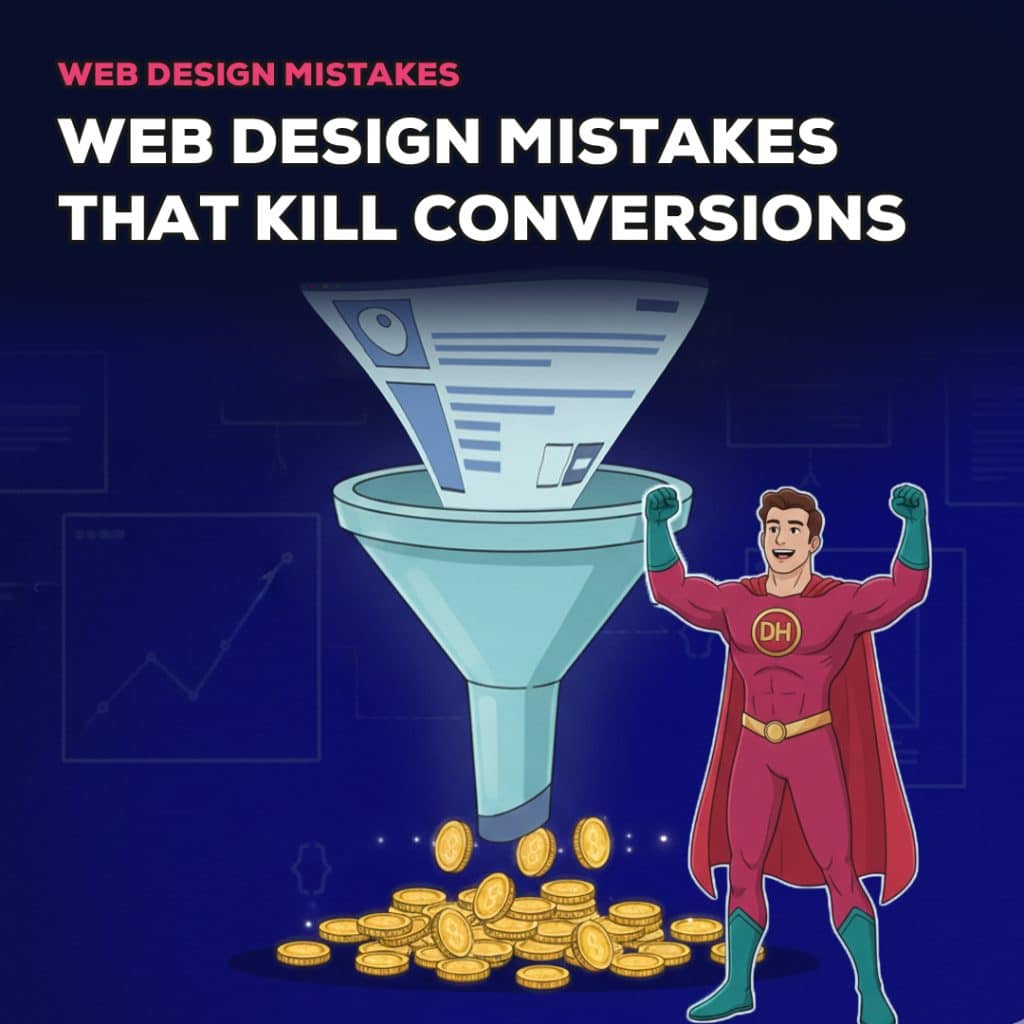
Common Homepage Design Mistakes
Even experienced designers make these mistakes.
Vague headlines
If the headline could belong to any business, it belongs to none.
Too much animation
Movement distracts.
It rarely converts.
Too many calls to action
Choice overload leads to inaction.
No clear journey
Users do not know where to go next.
Overloading content
Trying to say everything at once kills clarity.
Ignoring mobile users
A broken mobile homepage is a broken website.
How Design Hero Designs High Converting Homepages
Most homepage projects fail because they start in the wrong place.
They start with layout.
They start with colours.
They start with “what looks good”.
That is not how conversion happens.
Here is how we approach homepage design.
Strategy before layout
Before any design work begins, we get clear on purpose.
We define:
- Who the homepage is for
- What problem it must solve
- What action matters most
This removes guesswork and keeps decisions focused.
Messaging before visuals
Words do the heavy lifting.
Headlines.
Subheadings.
Calls to action.
We refine messaging first, then design around it.
This ensures the design supports clarity, not the other way round.
Brand aligned design
The homepage must feel like the business.
Tone of voice.
Visual style.
Pacing.
Nothing generic.
Nothing forced.
Brand alignment builds trust without trying too hard.
Conversion focused structure
Every section earns its place.
Hero leads.
Trust reassures.
Content explains.
Calls to action guide.
If a section does not help conversion, it does not stay.
One point of contact
You deal with the person making decisions.
No handovers.
No confusion.
Clear progress.
This keeps projects efficient and aligned.
Designed for Scottish and UK businesses
Local context matters.
How people browse.
What builds trust.
What language resonates.
We design with that in mind.
Simple Homepage Conversion Checklist
You do not need tools to spot obvious problems.
Use this quick checklist.
Can users tell what you do instantly
If someone lands and is confused, the homepage has failed.
Is there a clear next step
Every homepage should guide action.
Does it build trust quickly
Proof should be visible early.
Is it easy to scan
Headings, spacing and structure should reduce effort.
Does it work well on mobile
Test it on a real phone.
If you answer no to more than one of these, conversions are being blocked.
Example Homepage Breakdown
Here is a realistic example to make this tangible.
Business goal
A service business wanted more qualified enquiries, not more traffic.
Homepage structure
- Clear headline focused on the core problem
- Short supporting statement that reinforced value
- Primary call to action above the fold
- Trust signals directly below
- Services overview kept high level
- Simple explanation of how the process works
- Secondary proof near the bottom
- Strong final call to action
Messaging decisions
Plain language.
Problem focused.
Confident without hype.
No buzzwords.
No vague claims.
Conversion improvements
- Bounce rate reduced
- Time on page increased
- Enquiry quality improved
Small structural changes delivered measurable results.
Why Most Homepage Redesigns Fail
This is worth stating clearly.
Many homepage redesigns fail because the same mistakes are repeated.
- Design decisions made without strategy
- Messaging copied from competitors
- Focus on creativity instead of clarity
- No testing or iteration
A redesign that does not address these issues will not convert better.
Change without purpose is just decoration.
When a Homepage Redesign Is the Right Move
Not every homepage needs a full redesign.
A redesign makes sense when:
- The message no longer reflects the business
- The brand has evolved
- The structure feels chaotic
- Mobile experience is broken
- Conversion goals have changed
A redesign should still start with clarity, not aesthetics.
Conclusion
A homepage is not about creativity.
It is about clarity, trust and direction.
When a homepage works, everything else works better.
Traffic converts.
Users engage.
The business benefits.
If your homepage looks good but does nothing, it is not doing its job.
Design Hero helps businesses across Scotland and the UK design homepages that guide action and deliver results.
No trends.
No guesswork.
Just strategy, clarity and conversion.
If you want honest input on what your homepage is doing wrong, speak with us.
We will tell you what matters and what does not.
About the author

Nicholas Robb, Founder
The original Design Hero founder, solopreneur and marketing expert; Nick will help you supercharge your business success with a broad skill-set spanning a range of digital marketing fields.
If you want help growing your business...