

What Branding Actually Means for a Startup
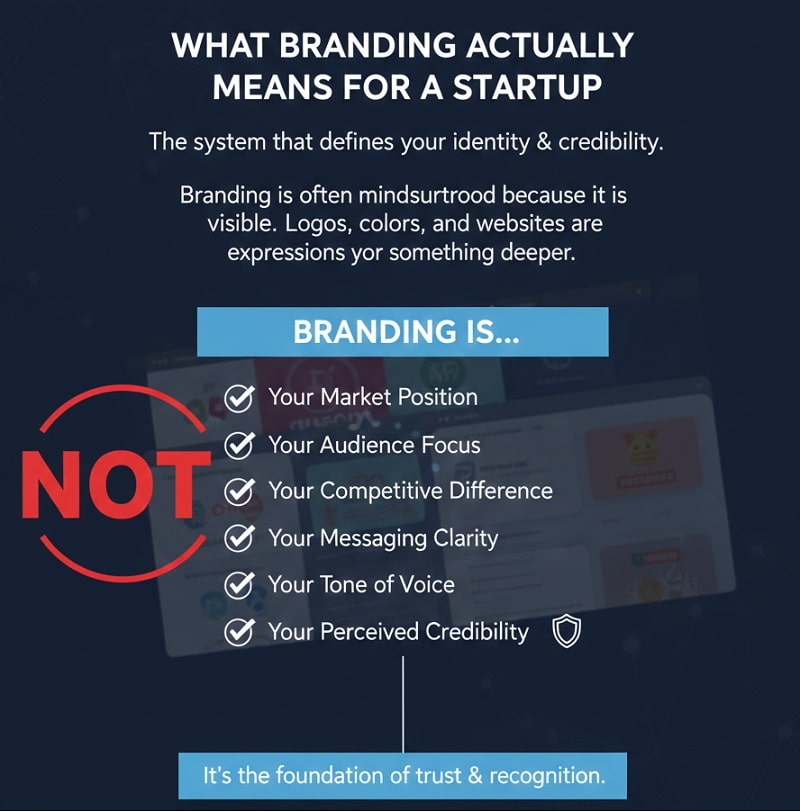
Branding is often misunderstood because it is visible.
People see logos, colours and websites, so they assume that is branding. In reality, those are expressions of something deeper.
For a startup, branding is the system that defines:
- Your market position
- Your audience focus
- Your competitive difference
- Your messaging clarity
- Your tone of voice
- Your visual language
- Your perceived credibility
Branding shapes how people categorise you in their mind.
Are you premium or accessible?
Innovative or reliable?
Specialist or broad?
Established feeling or disruptive?
These signals influence buying behaviour before price or features even enter the conversation.
In the UK market, customers are cautious. They compare. They research. They evaluate trust carefully. Branding is the filter through which all that evaluation happens.
If your startup brand feels confused, people hesitate. If it feels confident and coherent, people engage.
Branding is not cosmetic. It is cognitive.
Step 1: The Strategic Foundation: Positioning Before Presentation
The biggest mistake early stage founders make is jumping straight to design.
They choose a name. They hire someone to create a logo. They launch a basic website. Then they try to work out how to explain the business afterwards.
This reverses the order.
Positioning must come first.
Positioning answers the strategic questions that shape everything else:
Who are we for?
What exact problem do we solve?
Why should someone choose us over alternatives?
What do we want to be known for?
Without positioning clarity, branding decisions become random.
In competitive UK sectors such as fintech, ecommerce, professional services, health, sustainability and tech, standing out is not about volume. It is about focus.
A startup that tries to serve everyone will be outperformed by one that serves a clearly defined segment extremely well.
Clear positioning narrows your message but increases its power.
For example, compare these two approaches:
“We provide marketing services to businesses.”
“We help purpose led UK service businesses generate consistent enquiries through conversion focused web design.”
The second is sharper. It creates identity. It attracts a specific audience. It filters out the wrong one.
Positioning clarity reduces wasted effort later. It guides marketing channels. It influences website structure. It shapes investor conversations.
Without it, you build noise instead of a brand.
Step 2: Defining Your Ideal Customer With Precision
Positioning and audience are inseparable.
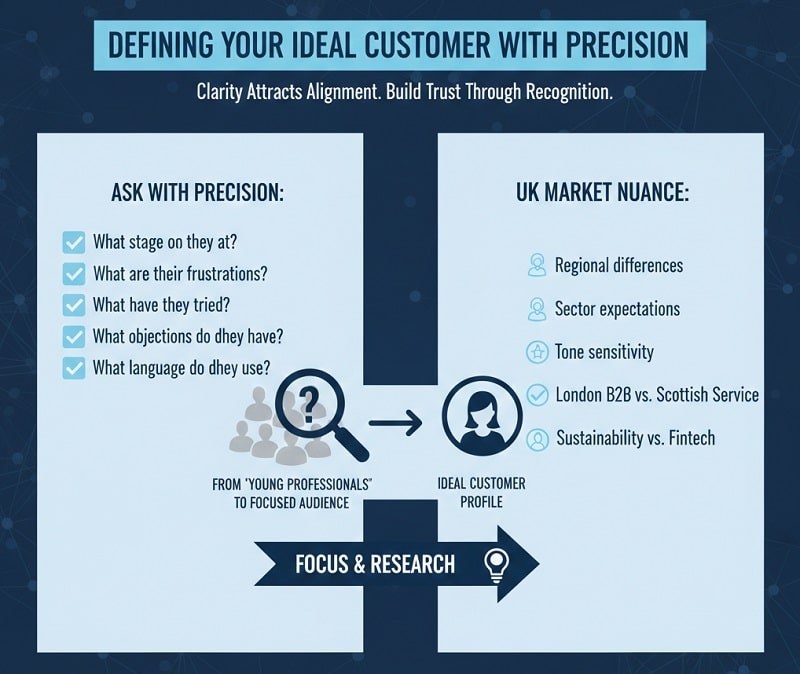
Many startup founders describe their audience in broad terms such as “small businesses” or “young professionals”. That level of definition is rarely sufficient.
Instead, founders should ask:
- What stage is my customer at?
- What frustrates them currently?
- What are they already trying?
- What objections will they have?
- What language do they use to describe their problem?
In the UK market, nuance matters. Regional differences, sector expectations and tone sensitivity influence how messaging is received.
A London based B2B startup may use sharper, faster messaging than a Scottish service brand. A sustainability focused brand may emphasise responsibility differently than a fintech platform.
Understanding your audience at this level allows you to design branding that feels intentional rather than generic.
Clarity attracts alignment. When your brand clearly speaks to a specific audience, those people recognise themselves in your messaging.
That recognition builds trust faster than any visual trick.
Step 3: Crafting a Compelling Value Proposition
Your value proposition is the core statement that explains why your startup deserves attention.
It must be: Clear, specific and outcome focused.
It does not need to be clever. It needs to be understandable in seconds.
Too many UK startups rely on phrases such as “innovative platform”, “next generation solution” or “industry leading service”. These phrases sound impressive but communicate little.
A strong value proposition answers three questions:
What do you do?
Who is it for?
What changes because of it?
For example:
“We help independent UK retailers increase online sales through conversion focused website design.”
That statement defines audience, service and outcome.
Clarity reduces friction in marketing. It improves website conversion. It strengthens sales conversations.
Your value proposition should influence your homepage headline, your LinkedIn bio and your investor pitch equally.
This is often referred to by marketing experts as your “offer”. An offer is a compelling pitch which conveys the value you offer.
Here’s a complete guide to creating an offer that sells
If you struggle to explain your startup in one or two clear sentences, branding work is not finished.
Step 4: Building a Messaging Framework That Scales
Branding is not a single line. It is a framework.
Once positioning and value proposition are defined, you build messaging pillars that support and reinforce your core idea.
Messaging pillars are consistent themes that define what your brand stands for. For a startup, these might include:
- Reliability and transparency
- Speed and efficiency
- Innovation and simplicity
- Ethical responsibility
- Specialist expertise
These pillars guide content creation, marketing campaigns and website structure.
Tone of voice also sits within this framework. Is your brand direct and confident? Conversational and supportive? Formal and authoritative?
In the UK market, authenticity tends to outperform exaggeration. Overstated claims create scepticism quickly.
Consistency across channels builds familiarity. Familiarity builds trust.
If your website sounds one way, your social media another and your sales emails another, credibility weakens.
Branding is alignment at scale.
Step 5: Visual Identity: Translating Strategy Into Recognition
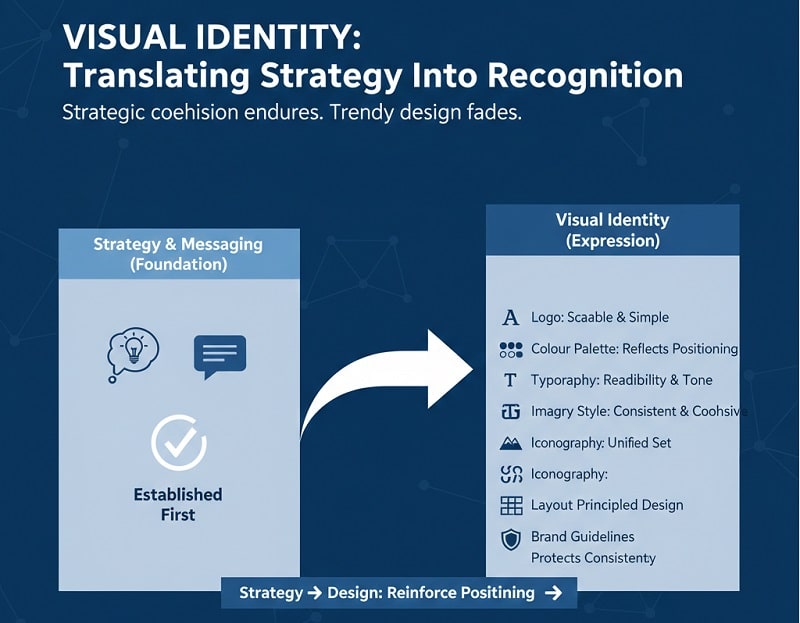
Visual identity translates strategy into something tangible. It should reinforce positioning, not contradict it.
Key components include:
- Logo
- Colour palette
- Typography
- Imagery style
Iconography - Layout principles
- Brand guidelines
A startup logo should be scalable and simple. It must work on a website header, a mobile app icon and printed material.
Colour influences perception immediately. Bold, energetic colours suggest ambition. Neutral palettes suggest professionalism and stability. The choice must reflect positioning.
Typography affects readability and tone. Modern sans serif fonts are common among startups, but legibility must always be prioritised.
Imagery style matters more than many realise. Consistent photography or illustration style creates cohesion. Random imagery creates fragmentation.
Brand guidelines are not corporate bureaucracy. They are protective tools. As the startup grows and new team members create content, guidelines ensure consistency.
Trendy design fades. Strategic cohesion endures.
Aligning Brand and Website From Day One
For most UK startups, the website is the primary brand touchpoint.
It must communicate positioning clearly within seconds.
The homepage should reinforce your value proposition immediately. Visitors should not need to scroll extensively to understand what you offer.
Navigation structure should reflect customer priorities, not internal thinking.
Calls to action should feel aligned with brand tone. Aggressive sales tactics rarely resonate well with UK audiences. Clarity and professionalism convert more effectively.
Mobile performance is critical. UK traffic is heavily mobile driven. If your site feels awkward on a phone, credibility suffers instantly.
A brand aligned website turns strategy into performance.
Applying Your Brand Consistently Across Every Channel
Branding is not finished when the logo is approved and the website goes live.
A startup brand becomes real through repetition and consistency.
Every touchpoint reinforces perception. Every inconsistency weakens it.
For UK startups, consistency matters because audiences are comparison driven. Customers often check your website, LinkedIn, Instagram and Google reviews before engaging. If those experiences feel disconnected, doubt creeps in.
Your website should reflect your messaging pillars clearly. Your social media should carry the same tone of voice. Your email communication should sound like the same business. Your advertising visuals should align with your brand guidelines.
Consistency does not mean repetition of the same sentence everywhere. It means coherence.
Your personality should be recognisable across channels. Your visual style should feel familiar. Your message should not contradict itself depending on platform.
Early stage startups often struggle here because growth moves quickly. New team members join. Marketing experiments begin. Without clear brand guidelines, fragmentation happens fast.
Strong branding provides guardrails that allow growth without confusion.
Launching Your Brand With Clarity and Structure
A brand launch is more than a website going live.
It is the coordinated introduction of your business to the market.
Startups that launch effectively typically do three things well:
They communicate clearly, ensure consistency and prepare internally.
Clear communication means explaining your offer simply across all platforms at the same time. If your website says one thing but your LinkedIn bio says another, the launch loses impact.
Consistency means visual identity and messaging align everywhere. Profile images, banner graphics, tone of voice and calls to action should feel intentional.
Internal preparation is often overlooked. Your team should understand the positioning and messaging framework. They should know how to explain the business confidently.
For UK startups targeting investors or B2B markets, launch credibility matters significantly. Investors assess clarity and focus quickly. A confused brand suggests a confused business model.
After launch, early feedback should be monitored carefully.
Are users understanding the offer?
Are enquiries aligned with your intended audience?
Are customers asking the same clarification questions repeatedly?
Branding should remain stable, but messaging refinements based on real behaviour are healthy.
Common Startup Branding Mistakes in the UK Market
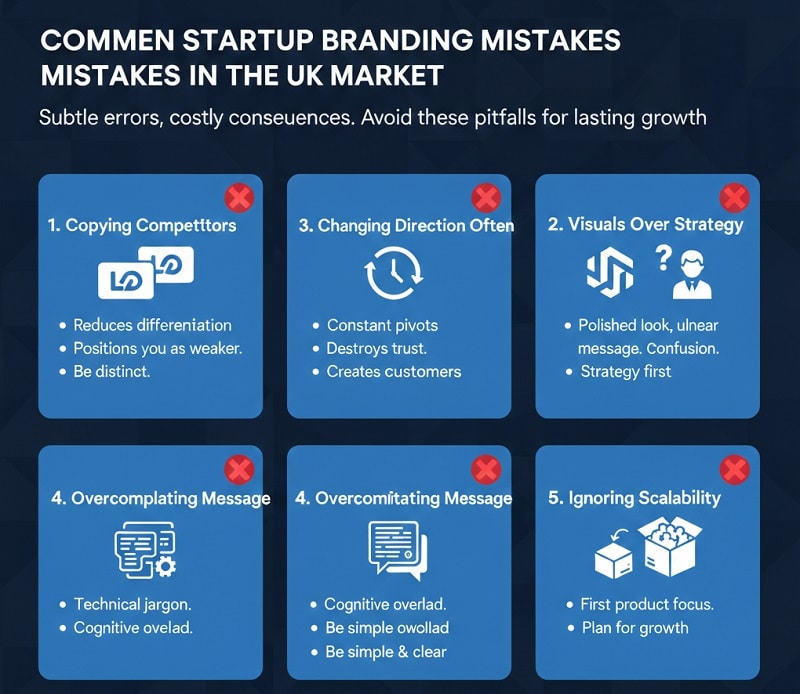
Branding mistakes are rarely dramatic. They are usually subtle but costly.
1. Copying Established Competitors
New founders often look at established players and mirror their style. It feels safe.
The problem is that customers already associate that style with someone else. Copying reduces differentiation and positions your startup as a weaker version of an existing brand.
Differentiation does not require extreme creativity. It requires clarity about what makes you distinct.
2. Prioritising Visuals Over Strategy
A polished logo without positioning clarity creates temporary excitement but long term confusion.
When strategy is unclear, the website must compensate with explanation. Marketing must compensate with persuasion. Sales must compensate with reassurance.
Strategic clarity reduces this burden.
3. Changing Direction Too Frequently
Early stage startups often pivot. That is natural.
However, constantly altering brand messaging, tone or visual style creates instability. Customers struggle to understand who you are.
Refinement is healthy. Reinvention every few months is damaging.
4. Overcomplicating the Message
Founders are close to their product. They understand technical nuance deeply. Customers do not.
Overcomplicated messaging creates cognitive overload. Clear brands communicate in simple language.
Especially in the UK, straightforward communication builds credibility faster than clever phrasing.
5. Ignoring Long Term Scalability
Some startups design branding around their first product version only. When they expand, the brand no longer fits.
Positioning should allow room for growth. Messaging should be specific but not restrictive.
Branding should scale with ambition.
Why Branding Matters Even More for Startups Than Established Businesses
Established businesses benefit from accumulated trust.
They have reviews, case studies, word of mouth and recognition.
Startups begin with none of that.
Branding becomes the proxy for credibility.
When a startup brand feels coherent, intentional and professionally presented, it signals competence before proof exists.
For investor backed startups, brand clarity influences funding conversations. Investors assess focus, differentiation and market understanding quickly.
For consumer startups, branding influences perceived value. Strong branding allows startups to avoid competing purely on price.
For B2B startups, branding influences trust. Companies are risk aware when choosing new partners. A clear, professional brand reduces perceived risk.
Branding accelerates trust building. Trust accelerates growth.
The Long Term Role of Branding in Startup Growth
Branding is not static. It evolves.
However, evolution should be controlled, not reactive.
As your startup grows, expands into new markets or launches new services, your brand framework should guide decisions.
Ask:
- Does this new product align with our positioning
- Does this marketing campaign reinforce our messaging pillars?
- Does this partnership reflect our brand values?
Strong brands create internal alignment. They reduce confusion in decision making.
Startups that treat branding as a one time task often find themselves rebranding within two years.
Startups that treat branding as strategic infrastructure rarely need dramatic changes. They refine rather than replace.
How Design Hero Approaches Startup Branding in the UK
At Design Hero, startup branding begins with strategic clarity.
We start with positioning workshops. We define audience, differentiation and market space. We challenge vague assumptions.
From there, we build messaging frameworks that align with commercial goals. Not abstract statements. Clear, usable messaging.
Visual identity is developed to support strategy. Not the other way around.
Branding and website development are integrated. This prevents the common disconnect between brand design and digital execution.
Clients work with one experienced point of contact. That clarity keeps the process focused and avoids dilution.
We build brands for UK and Scottish markets specifically. That means understanding tone expectations, regulatory context and local competition.
Our focus is commercial. We build brands that convert, scale and endure.
Want to know how Design Hero can help your startup – Book a free consultation call
Comprehensive Startup Branding Checklist
Before going to market, review this honestly:
- Positioning: Have you clearly defined who you serve and what makes you different?
- Audience: Do you understand your ideal customer’s motivations and objections?
- Value Proposition: Can you explain what you do and why it matters in one or two clear sentences?
- Messaging Framework: Do you have consistent messaging pillars guiding communication?
- Visual Identity: Is your brand visually cohesive and scalable?
- Website Alignment: Does your website reflect your positioning immediately?
- Channel Consistency: Are social media, email and marketing materials aligned?
- Scalability: Will your brand support growth and expansion?
If multiple answers feel uncertain, branding work is incomplete.
Conclusion: From Idea to Market With Confidence
Branding for startups is not about looking impressive. It is about being clear.
Clear positioning attracts the right customers. Clear messaging builds trust. Cohesive visuals reinforce credibility.
When startups skip strategy, they often end up rebranding later at greater cost. When branding is handled properly from the beginning, growth becomes smoother and more focused.
If you are building a startup in the UK and want to launch with clarity rather than guesswork, investing in proper branding is one of the smartest decisions you can make.
Design Hero helps UK and Scottish startups move from idea to market with confidence and commercial focus. If you want expert guidance on building a brand that supports real growth, we are always happy to have a straightforward conversation.