


Why Ecommerce Designing Pricing Varies So Much

An ecommerce website is a business system, not just a design project.
When you sell online, your website becomes your shopfront, sales assistant, payment terminal, stock room interface and marketing engine all at once.
The difference between a basic template store and a strategic ecommerce platform is significant. That difference shows up in price.
A low quote may reflect:
- A pre built theme with minimal customisation
- Limited product structure planning
- Basic checkout setup
- No SEO foundation
- No integration with marketing tools
A higher quote often reflects:
- Custom design aligned with your brand
- Structured product categories
- Conversion focused layout
- Marketing and SEO setup
- Integrated systems for long term growth
Understanding what sits behind the price is essential.
The Core Factors That Impact Ecommerce Website Costs
Understanding cost requires understanding scope. Below are the primary variables that influence ecommerce website pricing in the UK.
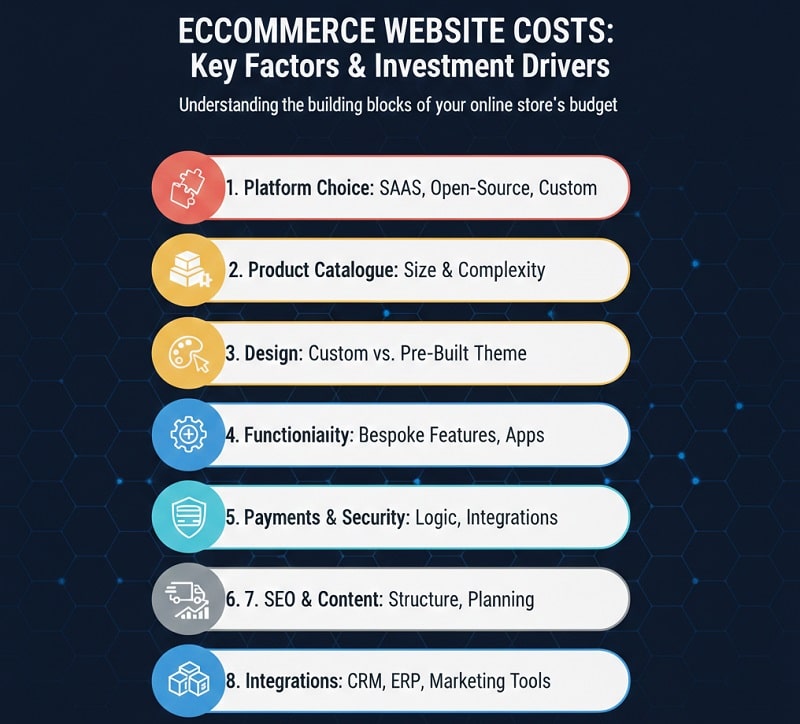
1. Platform Choice
Platform choice affects upfront build cost, ongoing subscription fees and long term flexibility.
Shopify is popular with UK retailers because it simplifies hosting, security and updates. It operates on a monthly subscription model. It is stable and scalable, making it ideal for many small to mid sized businesses.
WooCommerce, built on WordPress, offers high flexibility and ownership control. However, it requires hosting, plugin management and regular maintenance. It can be more customisable but may require more technical oversight.
The platform itself is not usually the most expensive element. The real cost comes from how much customisation and integration you require around it.
A basic Shopify theme setup will cost far less than a custom designed Shopify build with advanced functionality and integrations.
2. Product Catalogue Size
The number of products dramatically affects cost.
A store launching with 15 products requires limited structure. A retailer with 800 products needs:
- Structured category hierarchy
- Advanced filtering
- Bulk upload systems
- SEO logic planning
- Inventory organisation
Product architecture is strategic. If it is rushed, customers struggle to navigate. Poor navigation directly reduces conversion rates.
Larger catalogues demand deeper planning, and planning takes time.
3. Custom Design vs Pre Built Theme
Template based ecommerce builds are less expensive because the structural framework already exists. However, they limit differentiation and conversion optimisation.
Custom ecommerce design involves:
- Brand aligned layouts
- Unique homepage structure
- Conversion focused product pages
- Strategic call to action placement
- Optimised checkout experience
Templates can be suitable for startups testing early market traction. Growth focused retailers benefit from custom structure because it supports higher conversion rates and stronger brand positioning.
Custom design requires more UX thinking, more wireframing and more development refinement. That investment influences price.
4. Functionality Requirements
Basic ecommerce allows customers to purchase products.
Advanced ecommerce introduces additional layers such as:
- Subscription products
- Membership areas
- Bundled offers
- Tiered pricing
- Wholesale portals
- Click and collect
- Booking systems
- Multi currency support
- Advanced filtering systems
Each new feature requires configuration, testing and optimisation.
For example, subscription functionality involves recurring billing logic, customer account management and cancellation workflows. That is not a simple add on. It is a system layer.
Retailers often underestimate how much these features impact development scope.
5. Payment Gateways and Security
UK ecommerce stores typically integrate payment systems such as Stripe, PayPal, Apple Pay or Klarna.
Basic integration is straightforward. However, if you require:
- Multiple payment gateways
- International payment handling
- Fraud detection systems
- PCI compliance review
- Subscription billing support
The build complexity increases.
Security is not optional. Customers expect visible trust indicators and seamless checkout flows. Any friction during payment directly affects sales.
6. Shipping and Fulfilment Complexity
Shipping is one of the most underestimated cost drivers.
If your store only offers flat rate UK shipping, setup is simple.
However, complexity increases when you require:
- Weight based pricing
- Location specific rates
- Free delivery thresholds
- International shipping rules
- Click and collect integration
- Real time courier API integration
Each layer requires configuration and testing.
Shipping errors damage trust quickly. Proper setup is critical.
7. SEO Structure and Content Planning
Many cheap ecommerce builds ignore SEO during setup. That mistake becomes expensive later.
Proper ecommerce SEO includes:
- Structured URL architecture
- Optimised category pages
- Internal linking logic
- Schema markup
- Product metadata setup
- Crawl efficiency planning
If SEO is built in from the beginning, long term visibility improves significantly.
If it is not, rebuilding the structure later becomes complex and costly.
Strategic planning increases initial cost slightly but improves long term ROI dramatically.
8. Third Party Integrations
Modern ecommerce rarely operates independently. Retailers often require integration with:
- CRM systems
- Email marketing platforms
- Stock management software
- Accounting tools
- POS systems
- Fulfilment platforms
Each integration adds development and testing time.
Integration mistakes cause operational issues. Done properly, they improve efficiency and scalability.
Realistic Ecommerce Website Cost Ranges in the UK
While every project differs, realistic budgeting brackets help remove uncertainty.
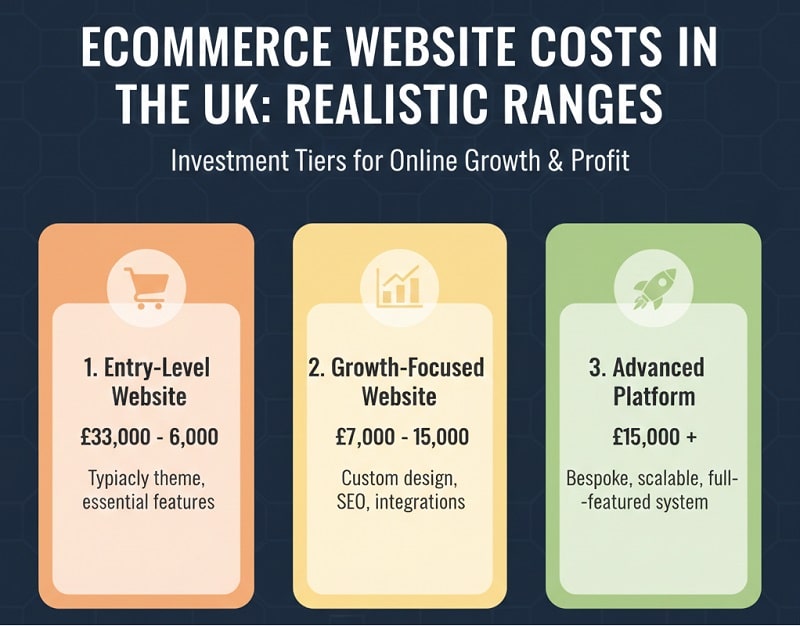
1. Entry Level Ecommerce Website
Typically £3,000 to £6,000
This usually includes a template based build with limited customisation. Product catalogue size is small. Functionality remains standard. SEO foundations may be basic.
Suitable for early stage businesses validating demand.
However, scalability and advanced optimisation may be limited.
2. Growth Focused Ecommerce Website
Typically £7,000 to £15,000
This level includes custom design elements, structured product architecture, SEO integration and marketing tool setup.
Conversion focused thinking is embedded into the layout. Checkout flow is optimised. Email marketing integration is often included.
This bracket suits retailers serious about building a long term sales channel rather than a side experiment.
3. Advanced Ecommerce Platform
£15,000 and upwards
This category includes large catalogues, custom functionality, subscription systems, complex integrations and advanced performance optimisation.
These builds function as digital infrastructure. They support scale, automation and long term brand positioning.
The higher the strategic ambition, the greater the investment.
It is not about spending more for the sake of it. It is about matching build complexity to business objectives.
Ongoing Ecommerce Costs Retailers Must Budget For
Upfront design cost is only part of ecommerce budgeting. Ongoing expenses must be planned realistically.
1. Platform Fees
Shopify operates on monthly subscription tiers. WooCommerce requires hosting, which varies depending on traffic and performance needs.
2. Payment Processing Fees
Transaction fees apply to every sale. These are typically a percentage plus a fixed charge.
3. Maintenance and Updates
WooCommerce requires plugin updates and security monitoring. Shopify simplifies maintenance but may still require development support for feature updates.
4. Marketing Investment
An ecommerce website without marketing will not generate consistent sales.
Retailers must allocate budget for:
- SEO
- Paid advertising
- Email campaigns
- Social media promotion
Marketing spend often exceeds initial build cost over time.
5. Continuous Optimisation
High performing ecommerce stores test and refine constantly. A/B testing, landing page refinement and UX improvements drive growth.
Budget should include room for iteration.
Why Cheap Ecommerce Websites Often Cost More in the Long Run
It is tempting to choose the lowest quote when comparing ecommerce website costs in the UK. On paper, saving several thousand pounds feels sensible, especially for startups or retailers moving online for the first time.
However, cheap ecommerce builds frequently create hidden costs that surface months later.
The most common issue is structural weakness. Template builds often prioritise speed over planning.
Product categories are created quickly without deep thought about how customers search, browse and compare.
Navigation becomes cluttered. Filters do not function logically. Customers struggle to find what they want and leave without purchasing.
Another recurring problem is weak product pages. High performing ecommerce pages require more than a title and price. They need persuasive descriptions, clear benefits, trust indicators, structured information hierarchy and mobile optimisation.
Cheap builds often leave product pages thin and generic. As a result, conversion rates remain low even if traffic increases.
Checkout experience is another failure point. Long forms, confusing steps and lack of reassurance increase cart abandonment.
A strategic ecommerce build optimises checkout flow carefully. A rushed build simply connects payment processing and hopes for the best.
SEO is frequently overlooked. Without structured URL logic, optimised category pages and internal linking, your store struggles to rank in organic search.
Fixing SEO architecture later often requires partial rebuilds.
Scalability becomes a final obstacle. When a retailer grows and wants to add new features such as subscriptions, wholesale pricing or marketing automation, the original build may not support expansion cleanly. Additional development becomes complex and expensive.
In many cases, retailers who choose the cheapest ecommerce website cost option eventually reinvest to correct foundational issues.
That second investment could have been avoided with proper planning from the start.
How to Compare Ecommerce Website Quotes Properly
When evaluating ecommerce website quotes in the UK, price should not be the first filter. Scope clarity should be.
A well structured ecommerce quote should define exactly what is included. Product count should be specified. Platform choice should be justified.
Design scope should be clear. Functionality requirements should be itemised. SEO foundations should be referenced explicitly.
If a quote simply says “Shopify store build” without detailing structure, integration and optimisation, it leaves room for misunderstanding.
Retailers should also confirm whether mobile optimisation is prioritised. In the UK, a significant portion of ecommerce traffic comes from mobile devices.
If the mobile experience is not considered carefully, sales suffer immediately.
Ownership and access should be clarified. You should retain control of your store, domain and data. Support terms should be transparent. Ongoing maintenance expectations should be explained.
Ask whether SEO foundations are included. Ask whether product architecture planning is part of the scope. Ask whether conversion focused UX thinking informs layout decisions.
A lower price that excludes critical components is not cheaper. It is incomplete.
The Return on Investment: What an Ecommerce Website Should Deliver
When retailers focus purely on upfront cost, they miss the larger picture. An ecommerce website should not be evaluated as a design expense. It should be evaluated as a revenue generating asset.
A properly structured ecommerce website should deliver measurable outcomes.
First, improved conversion rates. Clear navigation, persuasive product pages and optimised checkout increase the percentage of visitors who purchase.
Second, higher average order value. Strategic product recommendations, bundling and upselling encourage customers to spend more per transaction.
Third, stronger customer retention. Email integration, account management and marketing automation build repeat purchasing behaviour.
Fourth, improved visibility. Structured SEO enables category and product pages to rank in search engines, reducing reliance on paid ads.
Fifth, scalability. A well planned platform supports growth without structural reinvestment.
The conversation should shift from “How much does an ecommerce website cost?” to “What revenue should this website generate over three years?”
Investment should align with ambition.
Hidden Cost Traps Retailers Overlook
Ecommerce website pricing discussions often focus on build cost alone. However, hidden cost traps can distort budgeting.
One common oversight is underestimating content production. Product photography, copywriting and imagery require investment. Poor visuals reduce trust instantly. Professional content supports both conversion and SEO.
Another overlooked area is marketing infrastructure. Retailers sometimes invest heavily in the build but allocate minimal budget to advertising, email marketing or SEO. Traffic does not appear automatically.
Performance optimisation is another hidden cost. High resolution imagery and advanced functionality can slow page load times if not managed correctly. Speed optimisation may require additional refinement.
Integration costs can also surprise retailers. Connecting your ecommerce platform to accounting systems, stock software or third party tools may require development time beyond the original quote.
Understanding the full operational picture protects you from underbudgeting.
Platform Specific Cost Considerations
Because many UK retailers compare Shopify website cost UK and WooCommerce website cost UK specifically, it is worth addressing both briefly.
Shopify typically includes hosting, security and infrastructure within its subscription fee. Build costs relate mainly to design, customisation and integration. Monthly platform costs are predictable, but advanced apps may add additional subscription fees.
WooCommerce often involves lower monthly platform costs but higher responsibility for hosting performance, security updates and plugin management. Development flexibility is high, but technical oversight must be consistent.
Neither platform is inherently cheaper long term. Suitability depends on your operational model, internal capacity and growth strategy.
The right choice balances ease of use, scalability and budget realistically.
Planning Your Ecommerce Budget Strategically
Retailers moving online often focus on initial launch. Strategic budgeting considers the first 24 to 36 months.
You should define your initial product range clearly. Expansion plans should be considered from the outset. Platform choice should reflect where you intend to be, not just where you are today.
Marketing allocation should be defined alongside the website development budget. Launch without traffic generates limited insight.
You should plan for iteration. Data gathered after launch informs optimisation decisions. Budget flexibility supports growth.
Finally, think in terms of revenue targets rather than just launch milestones. If your ecommerce website costs £10,000 but generates £150,000 in revenue over two years, the return is clear.
How Design Hero Approaches Ecommerce Website Pricing
At Design Hero, ecommerce website design costs are defined through strategy first. Before discussing numbers, we clarify product complexity, audience expectations and commercial goals.
We do not rely on vague estimates. We break scope into transparent components. Retailers understand what they are investing in and why it matters.
Because branding, UX and SEO are integrated into our process, ecommerce builds are structured for performance, not just aesthetics. Mobile optimisation, product architecture and conversion pathways are considered from day one.
Retailers work with one clear point of contact throughout the project. Communication remains consistent. Scope remains defined. There are no hidden surprises.
Our focus is not on delivering the cheapest ecommerce website. It is on delivering the most commercially effective one within your realistic budget.
For UK and Scottish retailers serious about long term growth, clarity and structure protect your investment.
Want an accurate quote for your ecommerce website – Contact Design Hero
Ecommerce Budget Planning Checklist
Before requesting ecommerce website quotes, review the following:
- Have you defined how many products will launch initially?
- Have you clarified your revenue targets for the first year?
- Do you understand your customers’ buying journey?
- Have you chosen a platform that supports growth?
- Have you allocated marketing budget alongside build cost?
- Have you considered integration requirements with accounting, CRM or stock systems?
- Are you budgeting for ongoing optimisation?
Answering these questions ensures your ecommerce website cost aligns with your commercial objectives.
Final Thoughts: Budgeting With Clarity, Not Guesswork
Ecommerce website design costs in the UK vary widely because complexity varies widely. A small template store and a structured, scalable ecommerce platform are fundamentally different investments.
Retailers should avoid focusing purely on the lowest price. Instead, evaluate scope, structure and long term return.
Cheap builds often require correction. Strategic builds support growth.
An ecommerce website is not just a design project. It is digital infrastructure. It should increase revenue, strengthen brand positioning and scale with your business.
If you are comparing ecommerce website quotes in the UK and want clarity rather than confusion, the right conversation starts with goals, complexity and performance expectations.