

What Trust Signals Really Mean
Trust signals are often misunderstood as decorative extras. A badge here, a testimonial there, maybe a stock photo of a smiling team. That is not how trust actually works online.
Trust signals are proof.
- Proof that your business exists.
- Proof that you know what you are doing.
- Proof that other people have trusted you and had a good experience.
When someone lands on your website, they are quietly asking themselves whether this business feels safe to engage with.
They want reassurance without having to dig for it. The stronger your trust signals, the less effort they need to make a decision.
This is why trust and conversion are so closely linked. When trust is high, enquiries feel low risk. When trust is missing, even interested visitors hold back.
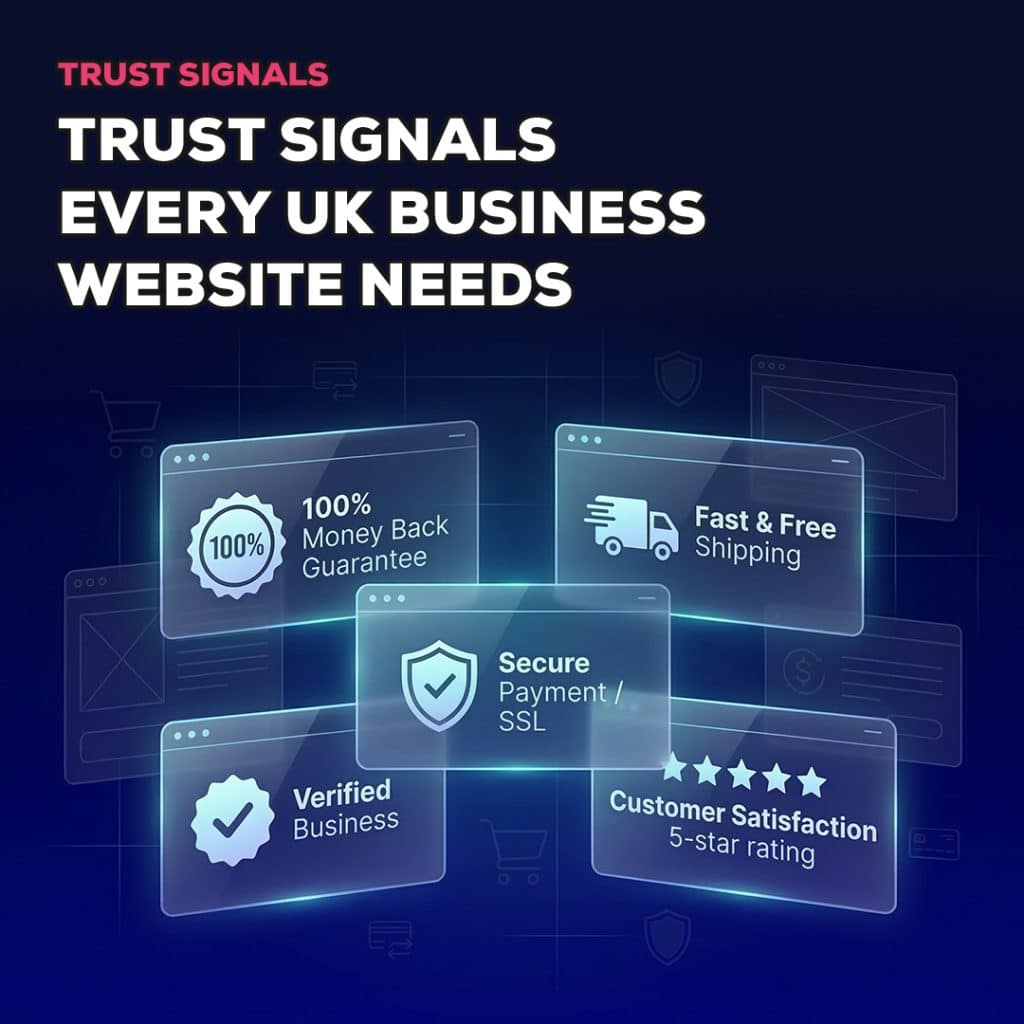
Core Trust Signals Every UK Business Website Needs
1. Clear and Visible Contact Details
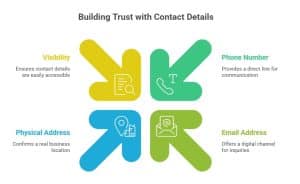
This is the most basic trust signal, yet it is still one of the most common problems we see.
UK users expect transparency. They want to see that there is a real business behind the website. When contact details are hidden, vague or missing, alarm bells start ringing.
A credible business website should clearly show a phone number, an email address and, where relevant, a physical address.
Even if most enquiries come through a form, people still want to know they could pick up the phone if needed.
Contact details should be easy to find without hunting. A visible footer, a clear contact page and, in many cases, a phone number in the header all help build immediate confidence.
2. Real Testimonials That Sound Human
Testimonials work when they feel genuine. They fail when they feel manufactured.
Generic praise like “great service” or “highly recommended” does very little on its own. UK audiences are particularly sceptical of vague claims. They want specifics.
Strong testimonials mention who the client is, what problem they had and what changed after working with you. Even short testimonials can be powerful if they feel real and grounded.
Where possible, include names, job titles or business names. Anonymous testimonials are better than nothing, but named ones always carry more weight.
Testimonials should also appear near key decision points, not hidden away on a single page no one visits.
3. Case Studies That Show Competence
Testimonials show satisfaction. Case studies show capability.
A case study does not need to be long or complex. What matters is that it clearly explains the situation, the approach and the outcome. UK buyers often want reassurance that you have handled similar challenges before.
Case studies are especially important for service-based businesses where the value is not immediately obvious.
They help potential clients understand how you work and what results look like in practice.
Even one or two solid case studies can dramatically improve trust, particularly when linked from service pages or highlighted on the homepage.
4. An About Page With Personality
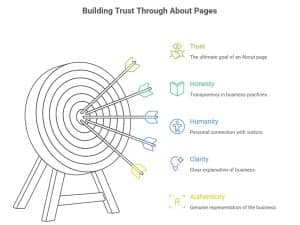
People do not just buy services, they buy from people.
An About page is often one of the most visited pages on a business website, especially when someone is close to enquiring. If your About page feels generic, overly corporate or evasive, it undermines trust.
A strong About page explains who you are, why the business exists and how you work. It does not need to be overly personal, but it should feel honest and human
Stock photos pretending to be staff or vague mission statements do more harm than good.
Showing the people behind the business, even briefly, helps visitors feel more comfortable reaching out.
5. Professional and Consistent Branding
Branding is a trust signal whether you intend it to be or not.
Inconsistent fonts, clashing colours and mixed tones of voice make a website feel unpolished. Visitors may not consciously notice what is wrong, but they will sense that something feels off.
Professional branding does not mean flashy design. It means consistency. Colours are used intentionally. Typography is readable and uniform. The tone of voice feels the same across pages.
When branding is consistent, it signals care, attention to detail and professionalism. All three directly affect trust.
6. Secure Website Indicators
Security matters, even for websites that do not sell online.
UK users are increasingly aware of data protection and privacy. If a website does not feel secure, people hesitate to fill in forms or share information.
Basic security indicators such as HTTPS, visible SSL certificates and simple reassurance around form submissions help reduce anxiety. This does not need to be overdone. In fact, too many security badges can look suspicious.
The goal is quiet reassurance, not fear-based messaging.
7. Reviews and Ratings From Trusted Platforms
Third-party reviews are one of the strongest trust signals available.
Google reviews, Trustpilot and industry-specific platforms provide validation that you cannot create yourself. UK users are familiar with these platforms and often look for them automatically.
Displaying review snippets on your website, with links back to the source, helps reinforce credibility. Even a small number of genuine reviews is more effective than dozens of vague testimonials.
The key is authenticity. Fake reviews or cherry-picked quotes without context damage trust rather than build it.
8. Clear Policies and Legal Pages
Policies are not just legal necessities, they are trust signals.
A clear privacy policy, terms and conditions and any relevant guarantees or returns policies show that you operate professionally. They reassure visitors that you have thought about their rights and expectations.
For UK businesses, GDPR awareness is particularly important. Users may not read your privacy policy in full, but they want to know it exists and is accessible.
Policies should be easy to find, written clearly and kept up to date.
9. Accreditations and Memberships That Matter
Accreditations can add credibility, but only when they are genuine and relevant.
Industry memberships, certifications or recognised bodies can reassure visitors that you meet certain standards. However, using outdated, irrelevant or obscure badges can backfire.
Quality matters more than quantity. A small number of recognisable accreditations placed thoughtfully is far more effective than a cluttered row of logos.
10. High Quality, Well Written Content
Content quality reflects business quality.
Spelling mistakes, broken sentences and outdated information quickly undermine trust. Visitors may forgive a typo in a blog post, but not across core pages.
Clear, well-structured content shows competence and care. It demonstrates that you understand your audience and respect their time.
This applies to every page, not just the homepage. Trust is built through consistency across the entire site.
11. Social Proof Beyond Testimonials
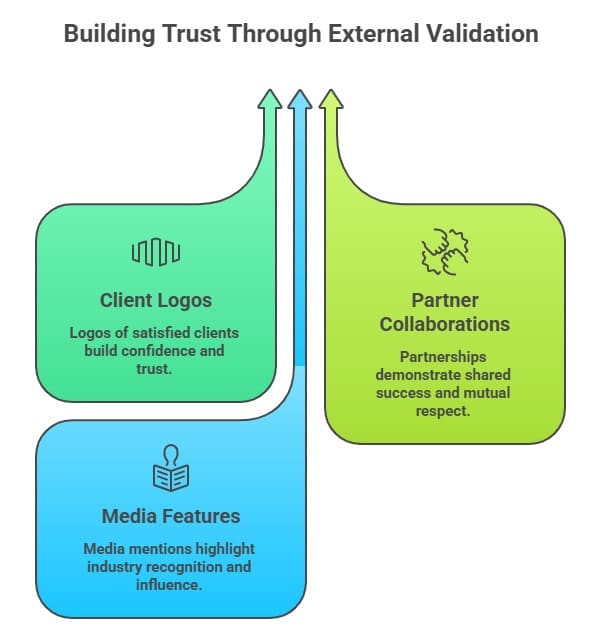
Social proof goes beyond written reviews.
Logos of clients you have worked with, partners you collaborate with or media outlets that have featured you all add credibility. They signal that others are willing to be publicly associated with your business.
As with all trust signals, honesty matters. Only use logos and mentions that are accurate and current.
12. Confident and Consistent Calls to Action
Calls to action are trust signals too.
Overly aggressive CTAs feel desperate. Overly vague ones feel uncertain. The right balance feels confident and professional.
A good CTA invites action without pressure. It makes the next step clear and feels aligned with the tone of the rest of the site.
Consistency matters here as well. Mixed messaging across CTAs can create doubt at the moment of decision.
Trust Signals That Matter More for UK Audiences
Trust is not universal. What builds confidence in one country does not always translate in another.
UK audiences have their own expectations, habits and red flags, and websites that ignore this often struggle to convert.
One of the biggest trust factors for UK users is local relevance. People want to know where a business is based and whether it understands the UK market.
A vague “we work worldwide” message with no clear location can feel impersonal and evasive.
Even businesses that serve the whole country benefit from clearly stating they are UK based, and where appropriate, highlighting a specific city or region.
Language and tone also play a role. UK audiences tend to respond better to clear, plain English than hype-driven marketing language.
Overly salesy copy, exaggerated claims or Americanised phrases can feel out of place and reduce credibility. A confident but grounded tone usually performs far better.
Transparency around pricing is another important trust signal for UK users. While not every business can list exact prices, vague promises like “affordable solutions” or “competitive rates” do little to build confidence.
Clear explanations of how pricing works, what affects cost or what is included help visitors feel informed rather than suspicious.
GDPR awareness is also a uniquely important factor. UK users are increasingly aware of data protection and privacy.
Websites that clearly reference GDPR compliance, cookie consent and responsible data handling feel more trustworthy than those that ignore it entirely.
Finally, business legitimacy matters. Clear business registration details, company numbers where relevant and consistent branding across website and external platforms all contribute to a sense that the business is established and accountable.
Common Trust Killing Mistakes
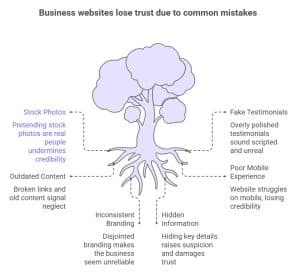
Many business websites lose trust without realising it. The site might look fine at a glance, but small details quietly undermine credibility and stop users from enquiring.
These are some of the most common trust killers we see on UK business websites.
1. Pretending stock photos are real people
Using stock imagery is not the problem. Pretending it represents your team is.
Visitors can usually tell when photos are staged or generic. When a “meet the team” section uses obvious stock images, trust drops immediately. It creates doubt about who the business actually is and whether they are being honest.
If you do not have real photos yet, it is better to be upfront than misleading.
2. Fake or overly polished testimonials
Testimonials that sound perfect rarely feel real.
Common red flags include:
- No names or business details
- Overly vague praise
- Identical wording across multiple testimonials
UK audiences are particularly sceptical of reviews that feel scripted. One honest, specific testimonial builds more trust than ten generic ones.
3. Broken links and outdated content
Nothing signals neglect faster than a website that feels out of date.
This includes:
- Broken links
- Old blog posts with no context
- Outdated offers or references
- Footers showing old copyright years
If a site feels neglected, visitors assume the business might be too.
4. Poor mobile experience
A website that works on desktop but struggles on mobile immediately loses credibility.
Common issues include:
- Text that is hard to read
- Buttons that are difficult to tap
- Forms that break or are awkward to use
Most users will not forgive these problems. They will leave and look elsewhere.
5. Inconsistent branding and messaging
When fonts, colours or tone change from page to page, the site feels disjointed.
Inconsistency makes it harder for users to form a clear impression of the business. If the website feels confused, visitors question whether the business is reliable.
Consistency builds confidence quietly but powerfully.
6. Hiding important information
When key details are hard to find, suspicion grows.
This often includes:
- Contact details buried in the footer
- No clear pricing guidance
- Missing policies
Transparency builds trust. Hiding information damages it.
How Design Hero Builds Trust Into Every Website
At Design Hero, trust is not something we add at the end of a project. It is built into the structure from the start.
We begin with strategy, not visuals. Understanding the business, the audience and the goals allows us to design websites that communicate clearly and confidently. When messaging is aligned with what the business actually does and who it helps, trust follows naturally.
Brand alignment is a key part of this. We make sure tone of voice, visual identity and messaging all work together. This consistency helps visitors quickly understand who the business is and what it stands for.
Trust signals are then built into the layout itself. Testimonials, case studies and proof points are placed where users need reassurance, not hidden away on isolated pages. Contact details are clear and accessible. Navigation is simple and logical.
We also prioritise clarity over cleverness. UK audiences value straightforward communication. We avoid buzzwords and overcomplicated language in favour of explanations that feel honest and human.
Finally, our clients deal with one point of contact throughout the process. That same clarity and accountability carries through into the websites we build. When a business is easy to deal with offline, its website should feel the same online.
Quick Trust Audit Checklist
If you want to quickly assess how trustworthy your website feels, use this simple audit.
- Can visitors easily see how to contact you without searching?
- Does the site look professional and consistent across all pages?
- Is proof visible near key decision points, not hidden away?
- Does the website work smoothly on mobile devices?
- Does the messaging feel honest, clear and grounded in reality?
If you hesitate on any of these, there is room to improve.
Conclusion
Trust is the foundation of every successful website. Without it, even strong traffic and great services struggle to convert.
UK business owners often focus on design aesthetics or SEO tactics while overlooking the basics of credibility. The reality is that small changes to trust signals can have a big impact on enquiries.
A website that feels clear, professional and honest makes it easier for visitors to take the next step. It removes friction and reduces doubt.
If you are planning a website rebuild, or if your current site looks fine but does not generate enquiries, it is worth taking an honest look at how trust is being communicated.
Design Hero helps businesses across Scotland and the UK build websites that people feel confident engaging with. If you want clear, practical advice on improving trust and conversions, we are always happy to have an honest conversation.