

Why Businesses Start With DIY Websites
Before discussing their limitations, it is important to recognise why DIY website builders exist and why they appeal to entrepreneurs in the first place.
For many startups and small businesses, budget is the primary reason. In the early stages, every pound matters. Spending thousands on a professionally built website may feel difficult to justify when the business is still validating its idea.
DIY platforms present themselves as affordable alternatives. With monthly subscriptions and ready made templates, business owners can create a website without a large upfront investment.
Speed is another major factor. Launching quickly can feel critical for new businesses. Website builders promise instant access to templates, drag and drop editors and pre built layouts. Within a few hours, a site can be live.
Ease of use also plays a role. Many platforms advertise themselves as “no coding required” solutions. This messaging reassures business owners who may feel intimidated by technical development.
Marketing from DIY platforms reinforces this appeal. Their messaging suggests that anyone can build a professional website in a weekend. For early stage founders eager to move quickly, this narrative is compelling.
At the beginning of a business journey, these platforms often provide enough functionality to get started. However, the very features that make DIY builders easy to use also create structural limitations later.
Signs Your DIY Website Is Holding Your Business Back
One of the challenges with DIY websites is that their limitations do not always appear immediately. A site may function adequately while traffic remains low and expectations are modest. As marketing activity increases, weaknesses become more obvious.
One common sign is difficulty updating or expanding the site. As a business grows, it often needs to add new services, pages or product categories.
DIY platforms rely heavily on templates. When businesses attempt to expand beyond those templates, layout issues appear. Pages become inconsistent or difficult to manage.
Another clear signal is weak SEO performance. Many DIY sites struggle to rank competitively in search engines. While platforms claim to support SEO, their underlying structure often limits deeper optimisation.
Businesses investing in content marketing or search visibility quickly encounter these limitations.
Design flexibility is another constraint. Templates are designed to look attractive initially, but they often restrict layout adjustments.
Businesses that want to refine messaging, emphasise particular services or create unique landing pages may find their options limited.
Performance issues also become noticeable. Page load speeds may slow as more images, scripts and content are added. Slow websites reduce user patience and negatively affect search rankings.
Conversion performance is often the most important indicator. Traffic may increase through advertising or social media, yet enquiries remain disappointing.
The website may look visually acceptable, but its structure does not guide users effectively toward action.
Finally, integration challenges emerge. Growing businesses rely on tools such as CRM systems, email marketing platforms, analytics software and payment gateways. DIY platforms frequently limit integrations or require complex workarounds.
When several of these issues appear simultaneously, the website begins to act less like a business asset and more like a bottleneck.
Structural Limitations of DIY Website Builders
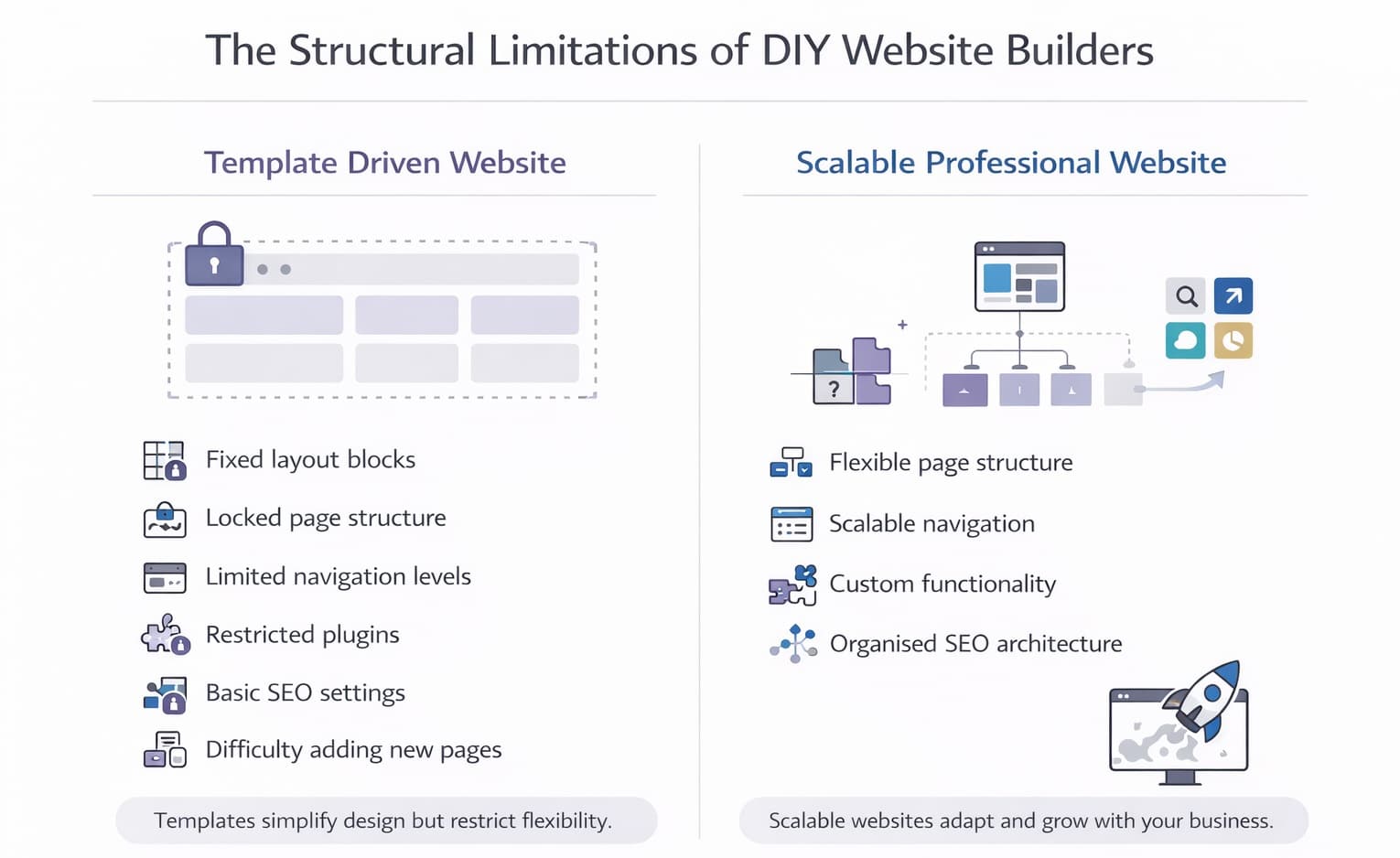
DIY website platforms are built around templates. Templates simplify the design process, but they also impose structural constraints.
A template determines layout, spacing, navigation structure and visual hierarchy. While some elements can be customised, the underlying framework remains fixed.
This creates challenges for businesses that want to refine their messaging or restructure their site as they grow.
For example, a service based company might initially use a single services page within a template. As the business expands and offers multiple specialised services, each service may require its own landing page for marketing and SEO purposes.
Templates often struggle to support this level of structural flexibility.
Custom functionality is another limitation. Growing businesses frequently require features such as advanced booking systems, membership portals, dynamic pricing or complex integrations. DIY platforms often restrict these capabilities or require expensive add ons.
Scalability becomes a concern as well. Platforms built for simplicity are not always designed to support large volumes of content or advanced functionality. As the site grows, performance and management complexity increase.
SEO structure is particularly affected by template limitations. Effective search optimisation requires logical page hierarchy, strategic internal linking and control over technical elements such as schema markup and indexing behaviour.
DIY platforms often simplify these features to maintain ease of use, which reduces optimisation potential.
These structural limitations rarely matter when a website contains only a handful of pages. As the site becomes a central marketing tool, they become increasingly problematic.
Conversion Problems With DIY Websites
Beyond technical limitations, one of the biggest issues with DIY websites is conversion performance.
Templates are designed to appeal to a broad audience. They prioritise visual balance rather than strategic messaging. As a result, many DIY sites follow generic layouts that fail to guide users toward action.
The homepage may look visually polished but lack a clear value proposition. Visitors arrive but struggle to understand exactly what the business offers or why it is different from competitors.
Calls to action are often weak or poorly positioned. Buttons may exist, but they are not integrated into a coherent user journey. Visitors browse briefly and leave without taking the next step.
User journeys themselves are frequently confusing. Instead of guiding visitors through a logical progression from introduction to solution to enquiry, DIY websites often present information in scattered sections.
Another common issue is inconsistent messaging. When business owners build their own site, they often write content page by page without a unified brand voice or messaging framework. The result is a website that feels fragmented.
Trust signals are also frequently overlooked. Testimonials, case studies and credibility indicators may be missing or hidden. Visitors cannot easily verify the legitimacy or expertise of the business.
These issues combine to reduce conversion rates significantly. Even with strong traffic, a poorly structured DIY website struggles to generate consistent enquiries.
SEO Challenges With DIY Platforms
Search engine optimisation is one of the most powerful long term growth strategies for businesses. Unfortunately, DIY platforms often create barriers to effective SEO.
While many website builders include basic SEO settings such as title tags and meta descriptions, deeper optimisation requires more control over site architecture and technical elements.
For example, effective SEO relies on structured content hierarchy. Service pages, supporting blog content and internal linking must work together to demonstrate authority on specific topics. Templates frequently make it difficult to organise content strategically.
URL structures may also be limited. Clean, keyword focused URLs are important for search visibility, but DIY platforms sometimes generate unnecessary parameters or rigid page structures.
Page speed optimisation can also be challenging. Templates often include scripts and design features that increase load times. While these features improve visual appeal, they can negatively affect performance.
Another challenge is content scalability. As businesses produce more articles, landing pages and resource content, managing internal links and site structure becomes more complex.
DIY platforms rarely provide advanced tools for this level of content architecture.
Over time, these SEO limitations reduce a business’s ability to compete in organic search results. Marketing investment increases, but the website struggles to support growth effectively.
The Hidden Cost of DIY Websites
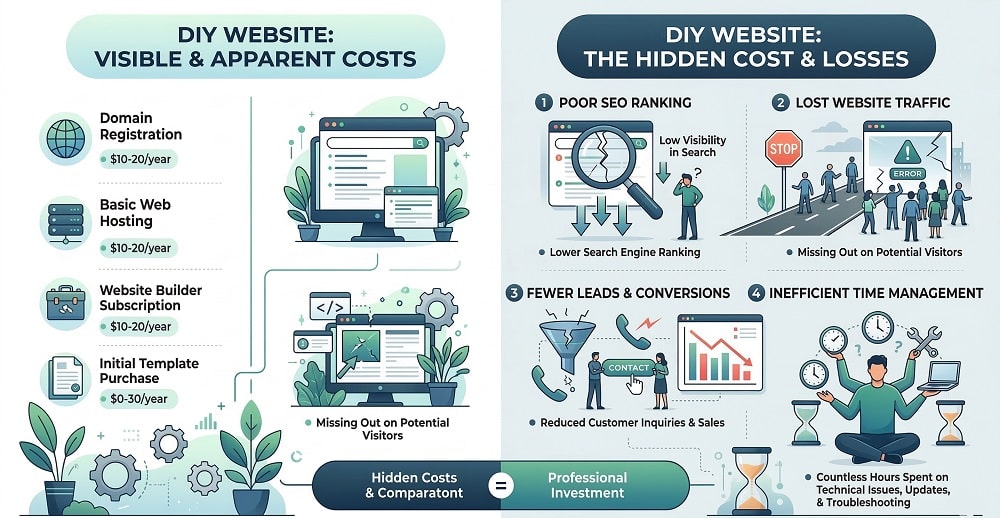
One of the biggest misconceptions around DIY website builders is that they save money. On the surface, the monthly subscription fees appear low. Compared with a professional web design investment, the difference can seem significant.
However, the real cost of a website is not measured only in development fees. It is measured in missed opportunities.
When a website fails to generate enquiries, the business loses potential customers every day. When SEO performance remains weak, competitors capture valuable search traffic. When the user experience feels generic or confusing, visitors leave before taking action.
These losses accumulate quietly. They do not appear as a single invoice, which makes them easy to overlook.
Consider a service business investing in digital marketing to drive traffic. Advertising campaigns may generate thousands of visits per month. If the website converts poorly due to unclear messaging or weak structure, a large percentage of those potential customers disappear.
Over time, the cost of lost leads can far exceed the original investment required for a professional website.
DIY websites also create inefficiencies in daily operations. Business owners may spend hours attempting to update layouts, troubleshoot formatting issues or integrate tools that do not connect easily. Time spent fighting with the website is time not spent growing the business.
Another hidden cost appears when businesses eventually decide to upgrade. Migrating from a DIY platform to a professional system often requires rebuilding the entire website from scratch.
Content must be transferred, SEO structure must be preserved and new systems must be configured carefully.
In many cases, the total cost becomes higher than if the business had invested in a scalable website earlier.
This is why DIY websites should be viewed as temporary solutions rather than long term foundations.
When It Is Time to Move Beyond DIY Platforms
For many businesses, the transition away from a DIY website happens gradually. Growth exposes limitations that were not visible in the beginning.
One of the clearest signals is increasing marketing investment. When a business begins spending more on advertising, SEO or content marketing, the website must perform as a conversion tool. If the site cannot convert traffic effectively, marketing spend becomes inefficient.
Another signal is brand evolution. As companies grow, their positioning often becomes more specialised. Messaging becomes more refined.
The brand identity develops greater clarity. DIY templates rarely support this level of differentiation.
Expansion into new services or product categories can also trigger the need for an upgrade. Growing businesses require structured landing pages, detailed service explanations and strategic navigation. Templates struggle to accommodate complex site architecture.
Technical integrations are another indicator. Modern businesses rely on CRM systems, email automation tools, analytics platforms and booking systems.
When these tools fail to integrate smoothly with a DIY website, operational friction increases.
Performance metrics often reveal the problem clearly. High traffic combined with low conversion rates suggests that visitors are not finding the clarity or trust they need to act.
Finally, scalability becomes critical. Businesses with long term growth ambitions require websites that can evolve with them. Professional web design focuses on building flexible foundations rather than static templates.
Recognising these signals early allows businesses to upgrade strategically instead of reacting when problems become severe.
Why Professional Web Design Changes the Outcome
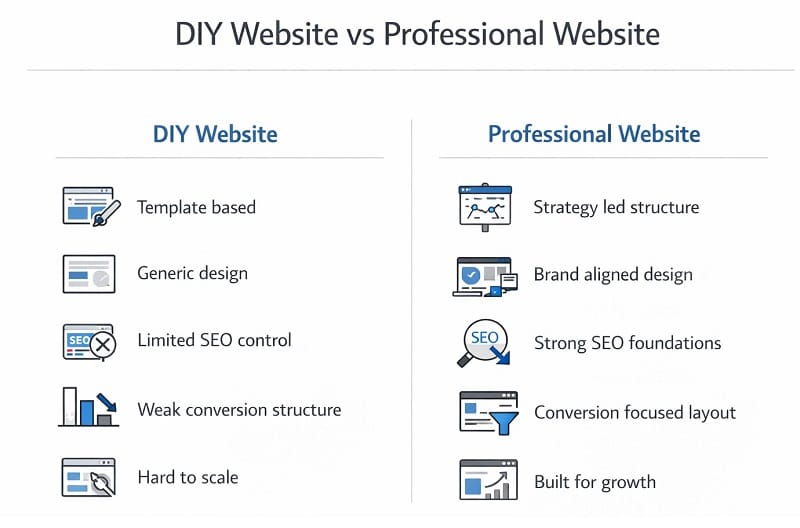
Professional websites are built differently from DIY websites because they begin with strategy.
Instead of selecting a template and adjusting content to fit it, professional web design starts by understanding the business itself.
Who are the ideal customers? What problems do they want solved? What makes the business different from competitors?
These insights shape the entire website structure.
Navigation is designed around how users search for information. Messaging is developed to communicate value quickly and clearly. Visual design reinforces brand identity rather than relying on generic templates.
Professional web design also prioritises conversion. Calls to action are placed strategically. User journeys are mapped carefully from entry point to enquiry. Trust signals are integrated throughout the experience.
Technical performance is another advantage. Professional builds consider page speed, mobile responsiveness and SEO architecture from the beginning. This ensures that the website supports long term marketing efforts.
Flexibility is equally important. Custom websites are built with scalability in mind. As businesses add services, expand into new markets or introduce new marketing channels, the website can evolve without structural limitations.
This strategic foundation allows the website to function as a genuine business asset rather than a static brochure.
How Design Hero Helps Businesses Upgrade From DIY Websites
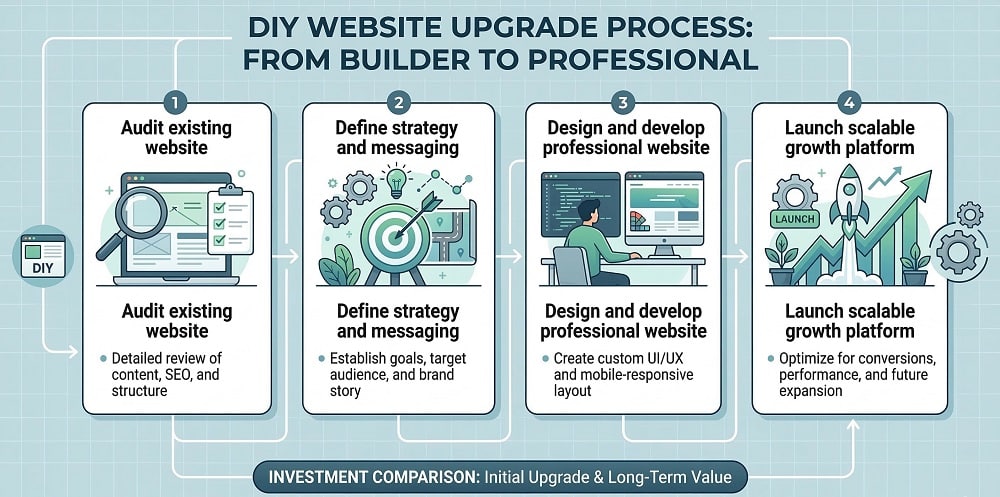
When businesses reach the point where their DIY website is limiting growth, the transition to a professional platform must be handled carefully.
At Design Hero, the process begins with understanding the business rather than jumping straight into design. The goal is to identify what the website needs to achieve commercially.
Strategy defines structure. Navigation, content hierarchy and user journeys are planned before visual design begins. This ensures that the website communicates value clearly and guides visitors toward action.
Brand alignment is also critical. As businesses grow, their brand identity often evolves. A professional website should reflect that maturity and credibility.
Conversion focused design ensures that the website does more than look attractive. It must generate enquiries, support marketing campaigns and reinforce trust with potential customers.
Technical foundations are built with scalability in mind. Platforms are selected based on the business’s future needs rather than just current requirements.
Another advantage is simplicity of communication. Instead of dealing with a faceless agency structure, clients work with a clear point of contact who understands both strategy and execution.
For growing UK businesses, upgrading from a DIY website is not just a design project. It is a step toward building a stronger digital foundation for the next stage of growth.
Want to know how your website can be improved – Contact Design Hero
DIY Website Exit Checklist
If you suspect that your DIY website may be holding your business back, it can be helpful to step back and evaluate the situation objectively.
Start by asking whether your website consistently generates enquiries or sales. If marketing campaigns produce traffic but conversions remain low, the problem may lie in the structure or messaging of the site.
Consider your SEO performance. Are you able to rank for relevant search terms in your industry, or does your website struggle to appear in results?
Evaluate the flexibility of your platform. Can you easily add new services, landing pages or integrations without significant limitations?
Reflect on your brand identity. Does your website reflect the professionalism and credibility of your current business, or does it feel generic?
Finally, assess how easy the site is to manage. If updating content feels unnecessarily difficult, the platform may be slowing you down.
When several of these indicators appear together, it is often a sign that the business has outgrown its original website solution.
Final Thoughts
DIY website builders play an important role in helping businesses get started online. They lower the barrier to entry and allow entrepreneurs to launch quickly with limited resources.
However, they are not designed to support long term growth.
As businesses expand, their digital presence must evolve as well. Marketing becomes more sophisticated. Brand positioning becomes clearer. Customer expectations increase.
A website built purely for convenience eventually becomes a limitation.
Professional web design provides the structure, flexibility and performance required to support growing businesses. It transforms a basic online presence into a strategic tool that attracts visitors, builds trust and converts interest into enquiries.
For businesses across Scotland and the UK experiencing growth, the question is not whether DIY websites work. The real question is how long they can support the ambitions of the business.
At some point, every growing company reaches the moment when its website must evolve.
When that moment arrives, upgrading to a professional solution is not just a design decision. It is a strategic step toward the next stage of growth.