


1. The Core Revenue Engine: Ticket Volume vs Total Cost Structure
At the centre of every competition business is one core principle:
Revenue must exceed total cost by a sustainable margin.
However, understanding total cost properly is where most beginners fail.
Let us break it down realistically.
Imagine a UK competition offering a Porsche valued at £60,000.
The company decides to sell 40,000 tickets at £3 each.
Projected revenue: 40,000 × £3 = £120,000
Now the real breakdown begins.
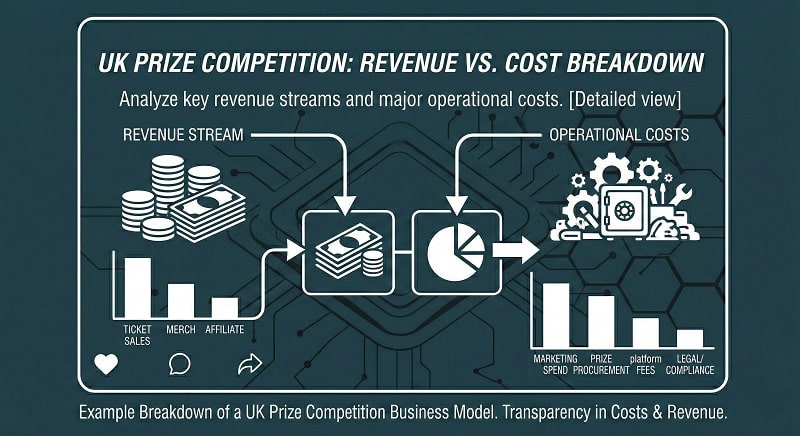
Prize Acquisition Cost. The car may be listed at £60,000 retail, but trade acquisition could be £54,000. Already, margin dynamics shift before a single ticket is sold.
Marketing Spend. To sell 40,000 tickets, the business may need paid social advertising, influencer promotions, retargeting campaigns and email automation. Marketing allocation could be £20,000 or more depending on audience size.
Payment Processing Fees. At 2.5 percent of £120,000, £3,000 disappears immediately.
Operational Overheads. These include website hosting and performance infrastructure, development and maintenance, customer service staff, insurance, legal advice, fraud monitoring and prize delivery logistics. Operational allocation may reach £7,000 to £10,000 per competition cycle.
Example Final Cost Model
Prize acquisition: £54,000
Marketing: £20,000
Payment processing: £3,000
Operations and overhead: £9,000
Total cost: £86,000
Projected profit: £34,000
That is a structured model. Not guesswork.
The formula underneath it is worth writing down properly, since it’s the single most useful number in this entire business: break-even point equals total costs divided by ticket price. In this example, £86,000 divided by £3 means roughly 28,667 tickets need to sell before the competition covers itself, out of 40,000 available. Everything sold beyond that point is profit. Everything short of it is a loss you need working capital to absorb, because most reputable operators guarantee the prize will still be awarded even if the competition doesn’t sell out, which is a promise worth making deliberately rather than by accident.
This disciplined modelling approach is the difference between stable competition businesses and those that collapse within a year of launch, undone by poor financial planning rather than a bad prize choice.
2. Psychological Pricing: Where Behaviour Meets Profit
Competition companies do not price randomly. They use behavioural economics.
The Power of Low Entry Pricing. A £2 or £3 ticket feels insignificant, reduces hesitation, encourages impulse decisions, and makes bundle offers more attractive. The lower the perceived barrier, the higher the participation rate.
Bundle Psychology. Consider the following pricing structure:
1 ticket for £3
5 tickets for £12
10 tickets for £20
Most users choose the middle option. Because it feels like better value, it avoids regret, and it increases perceived odds.
If the average order value rises from £3 to £14, profit scales rapidly.
Pricing structure directly influences margin far more than ticket cost alone. This is why strategic pricing is central to a sustainable model, and our own deep dive on how to price raffle tickets covers the psychology behind specific price points in far more depth than there’s room for here.
3. Volume-Based Model vs High-Margin Model
There are two dominant approaches in UK competition businesses.
Volume Model. Low ticket cost, high ticket quantity, lower margin per ticket, larger audience. Scales well, encourages repeat participation, and builds community, but requires strong marketing and is sensitive to traffic fluctuations.
High-Margin Model. Higher ticket price, lower volume, higher revenue per entrant. Needs a smaller audience and delivers a higher margin per conversion, but faces more psychological resistance and slower ticket sales.
In the UK market, the volume model often dominates because it aligns with consumer psychology, and it doesn’t have to be an either-or choice. Many of the most resilient operators run a high volume of small, low-cost draws to keep cash flow steady, then layer in the occasional big-ticket, high-margin competition to generate attention and headline entries. Relying entirely on one large prize is a riskier structure than most first-time operators realise, since a single underperforming draw can wipe out months of steady, smaller wins.
4. Customer Acquisition Cost vs Lifetime Value

The biggest silent killer of competition businesses is customer acquisition cost.
If it costs £15 in advertising to generate a £10 order, the model fails.
But consider this scenario: it costs £12 to acquire a new entrant. That entrant spends £15 on their first competition. Then enters four more competitions organically via email reminders. Lifetime revenue becomes £75.
The initial £12 acquisition cost becomes efficient.
This is why repeat entrants are critical. Competition companies that rely purely on one-off participants struggle. Those who build communities scale, and a well run email marketing programme is usually the cheapest, most reliable lever for turning a one-time buyer into a repeat one, since you’re no longer paying to reach the same person twice.
5. The Role of Marketing Channels in Profit
Most UK competition companies use Meta advertising, TikTok advertising, email marketing, organic social media, influencer partnerships and SEO.
Paid advertising creates immediate traffic but compresses margins. Organic visibility builds slower but increases profitability over time.
Companies investing in structured content and SEO reduce dependency on paid media, and organic search compounds in exactly the way paid traffic never does, since a competition page ranking well for a relevant search keeps generating entries long after the ad budget for that competition has been spent. When organic traffic grows, profit margins widen.
One compliance detail catches out a lot of new operators specifically on the paid side: Meta will not allow paid advertising for prize competitions without formal approval under its Real Money Gaming policy, commonly called RMG approval. This applies regardless of the fact that a properly structured UK prize competition is not classed as gambling under UK law. Meta’s own advertising rules sit entirely separately from the Gambling Act 2005, and one approval covers both Facebook and Instagram together. You can read Meta’s own requirements directly on the Meta Business Help Centre. Skip this step and the far more common outcome isn’t a warning, it’s an ad account restriction after a handful of ads have already gone live, sometimes before meaningful budget has even been spent. Our own paid advertising service factors this approval process into the campaign timeline from the outset, rather than treating it as an afterthought once ads are ready to launch.
6. Risk Management and Forecasting
Competition companies face several risks: ticket underperformance, rising ad costs, payment disputes, fraud attempts, compliance breaches and reputational damage.
Well-run businesses model minimum viable ticket sales, cap marketing spend, secure prizes at trade value and maintain clear compliance processes.
Risk planning is essential. Without it, even one poorly performing competition can erase previous profit. It’s worth looking at what that actually looks like in practice. Imagine a smaller competition offering a £700 technology prize across 2,000 tickets at 99p each, a maximum possible revenue of £1,980. If low ticket sales and free-entry promotions bring actual revenue down to around £950, and you subtract the £700 prize cost, roughly £450 in advertising, £38 in payment fees and £100 in operating costs, that competition posts a loss of close to £340 before tax. The competition itself wasn’t badly designed, the sales volume simply didn’t hit the forecast, which is exactly why conservative sales estimates matter more than optimistic ones when you’re setting a break-even target.
Because specialist payment providers often treat competition businesses as higher risk, it’s also common to have a portion of your revenue held back temporarily as a rolling reserve, a buffer the provider keeps in case of chargebacks or disputes. Factoring that into your cash flow planning avoids an unpleasant surprise the first time it happens.
7. Legal and Compliance Framework in the UK
UK competition companies must operate within legal boundaries.
They often structure draws as skill-based competitions, free-entry routes, or clearly defined prize competitions, in line with the Gambling Act 2005 and the Gambling Commission’s own guidance on prize competitions and free draws.
Failing to structure competitions properly can result in regulatory action, payment gateway restrictions, or advertising account bans.
A word of caution here, because the guidance in this space genuinely shifts: some payment providers have recently suggested that a clear, genuine free postal entry route alone may be sufficient without a separate skill question, provided the free route is properly structured. This is not settled legal advice, and interpretations can vary between providers and change over time, so the safer position for most operators is still to run both a skill question and a free entry route unless a qualified solicitor has advised otherwise for your specific business. Compliance costs money but protects long-term viability. This is not optional, and it’s worth reviewing your terms and conditions against the Advertising Standards Authority’s guidance on promotions and terms and conditions as well as ICO guidance on privacy notices and cookies before launch, since both regulators can and do take action against non-compliant competition sites.
8. Operational Systems Behind the Scenes
Behind every successful competition company is infrastructure: high-performance hosting, secure payment gateways, automated email systems, CRM databases, fraud detection and transparent winner verification.
Operational stability directly affects profitability. Poor systems increase refund rates, reduce trust, and damage revenue.
Two pieces of this infrastructure deserve specific attention because mainstream providers routinely decline this sector outright. Standard payment processors such as Stripe and PayPal frequently reject or restrict competition businesses due to their high-risk classification, so most operators end up working with specialist providers built for this exact niche. Our guide on how to choose a payment gateway provider for online competition sites walks through what to look for. Business banking follows a similar pattern, since many mainstream high street banks are cautious about competition and prize draw businesses, so it’s common to end up with a specialist or fintech provider rather than a traditional bank, and to describe your business plainly and accurately on any application rather than obscuring what it actually does. Being upfront about your business model at the application stage, rather than discovering a provider’s objections after you’re live, saves a lot of disruption later.
If you haven’t yet settled on which underlying platform to build on, our comparison of platforms for raffle websites is a useful starting point before committing to a build.
9. Trust as a Financial Asset
Trust is not just ethical. It is financial leverage.
Companies that publish winner photos, show live draw footage, maintain transparent terms and communicate clearly build repeat participation. Distrust reduces conversion rates dramatically. Long-term profitability is tied directly to reputation.
There’s a specific, very concrete way this plays out that’s worth understanding: publishing your total ticket count and price lets any visitor do the maths themselves. If a prize is worth £800 and you’re selling 200 tickets at £5 each, that’s £1,000 in maximum revenue, and anyone can see the prize is genuinely fundable. Platforms that hide their ticket counts, or never state how many entries exist, give a visitor no way to verify whether the economics behind a big prize actually add up, and that opacity is one of the fastest ways to look, and eventually become, unsustainable. It’s also worth being upfront that prizes are very often sourced at trade or wholesale prices rather than the retail figure advertised, since that’s standard, legitimate business practice rather than something to hide, and explaining it plainly tends to build more trust than pretending it isn’t happening.
Don’t overlook accreditations either. Proof of your business registration, your compliance documentation, and clear proof of prize ownership belong somewhere visible on the site, not buried in a footer nobody scrolls to.
10. A Second Revenue Stream Most Operators Overlook
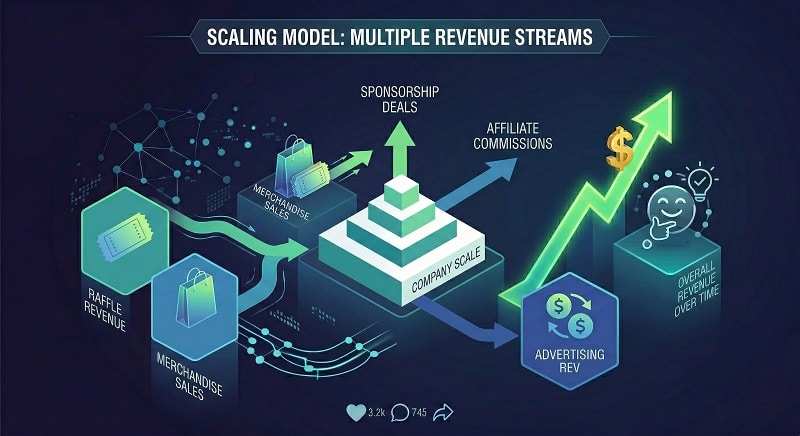
Ticket sales are the core of the model, but they don’t have to be the only income line. Brands will sometimes pay to have their product featured as a competition prize, or sponsor a draw outright, in exchange for the exposure your audience and marketing gives them. Affiliate links placed sensibly around the site, pointing to genuinely relevant products or services, can generate a modest additional income stream from existing traffic without asking entrants to spend anything further.
Neither of these should be treated as the main event. They work best as a supplement to healthy ticket sales, and as a way to build genuine partnerships that also act as a form of social proof, a recognisable brand attaching itself to your competition tells visitors someone else has already vetted you.
11. Scaling Beyond Single Competitions
Some competition companies scale through multiple concurrent competitions, tiered prize structures, recurring weekly draws, subscription-style entry models and cross-promotions.
Scaling introduces complexity but multiplies revenue potential. A subscription or membership-style entry model in particular deserves a proper look once you have a stable base of repeat entrants, and our review of membership website platforms is a useful starting point if that’s a direction you’re considering.
However, scaling without operational control increases risk. Structured growth matters.
Conclusion
Competition companies do not make money because people like cars.
They make money because pricing is structured intelligently, volume is forecast realistically, marketing spend is controlled, acquisition cost is monitored, repeat participation is encouraged, trust is maintained, and operations are stable.
Profit is not accidental. It is engineered.
The businesses that treat competitions as disciplined commercial models survive and scale. The ones that rely on hype, guesswork, or inflated expectations rarely last.
Competition companies make money when structure outweighs optimism.