


What Website Design Standards Actually Mean
When people hear the word standards, they often think of rules that limit creativity. In reality, website design standards exist to remove friction.
Standards define what users expect when they visit a professional website. They help people navigate easily, understand information quickly and feel confident taking action.
At a practical level, website design standards cover several key areas.
Usability ensures that visitors can use the site without confusion or effort. Accessibility ensures that content is readable and usable for as many people as possible. Performance ensures that the site loads quickly and behaves reliably. Compliance ensures that legal and regulatory expectations are met. Consistency ensures that everything feels intentional and trustworthy.
None of this is about chasing design trends. It is about meeting expectations.
UK users have clear expectations of how a professional website should work. When those expectations are met, trust increases. When they are not, doubt creeps in.
Core Website Design Standards UK Businesses Should Follow
These are the standards that consistently separate professional, high performing websites from the rest.
1. Mobile first design
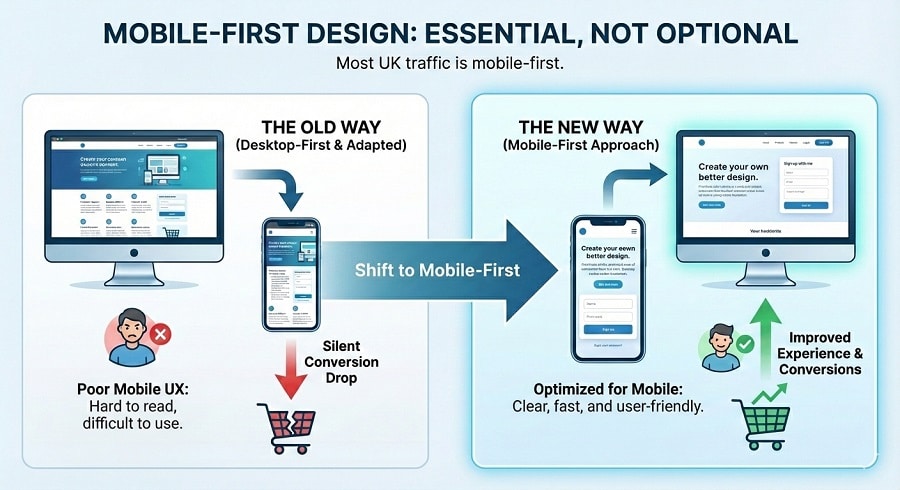
Mobile first design is no longer optional.
Most UK websites now receive the majority of their traffic from mobile devices. If a site is designed primarily for desktop and adapted later for mobile, problems usually appear.
Text becomes hard to read. Buttons are difficult to tap. Forms feel awkward. Users lose patience quickly.
A mobile first approach means designing for smaller screens from the beginning. Layouts prioritise clarity, spacing and ease of interaction. Desktop designs then scale up from a strong mobile foundation.
When mobile experience is poor, conversions drop silently.
2. Fast page load times
Speed is a fundamental design standard, not a technical bonus.
Slow loading pages damage trust before users even see the content. Visitors associate speed with professionalism and reliability, even if they do not consciously realise it.
For UK businesses, speed also affects search visibility. Search engines prioritise fast, well optimised websites because they deliver better user experience.
When speed is ignored, bounce rates increase and conversion rates suffer. No amount of visual design can compensate for a slow site.
3. Clear navigation
Users should never feel lost on a business website.
Navigation exists to guide people, not to show how much content a business has. When menus are cluttered or confusing, users hesitate and abandon journeys.
Clear navigation follows simple principles. Labels are obvious. Page hierarchy makes sense. Important pages are easy to reach without digging.
When navigation works well, users move confidently through the site. When it does not, even strong content goes unread.
4. Accessible design basics
Accessibility is a core standard, not an optional extra.
At a minimum, UK business websites should use readable fonts, sufficient colour contrast and layouts that work with keyboard navigation. Forms should be labelled clearly. Content should be easy to scan.
Ignoring accessibility limits who can use the site and damages credibility. It can also expose businesses to legal risk.
Accessible design improves usability for everyone, not just users with specific needs. It makes websites clearer, calmer and easier to use.
5. Clear calls to action
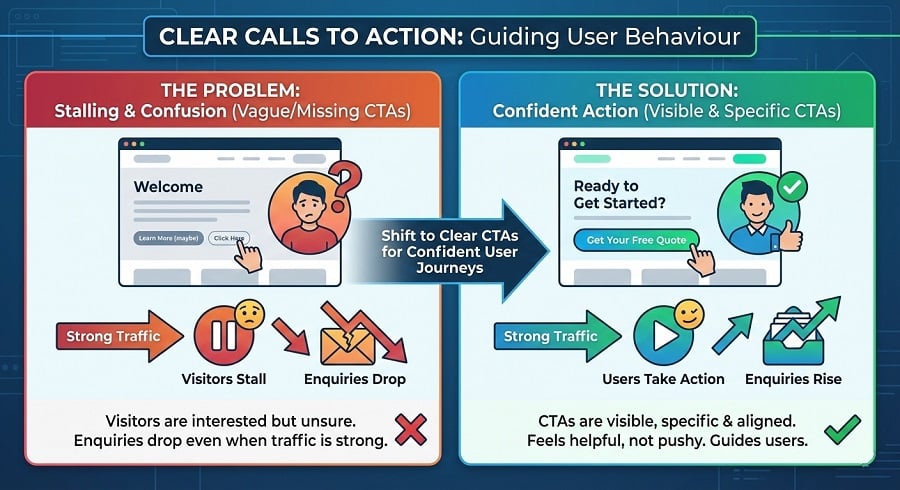
A professional website should guide behaviour.
Calls to action tell users what to do next. Without them, visitors stall. They may be interested, but unsure how to proceed.
Clear calls to action are visible, specific and aligned with the page content. They feel helpful rather than pushy.
When calls to action are vague or missing, enquiries drop even when traffic is strong.
6. Consistent branding
Consistency is one of the strongest trust signals a website can send.
Fonts, colours, tone of voice and visual style should feel cohesive across the site. When branding changes randomly from page to page, it creates doubt.
Inconsistent branding makes a business feel disorganised or unfinished. Visitors question whether the same level of care applies to the service itself.
Strong branding does not need to be loud. It needs to be consistent.
7. Secure website setup
Security is an expectation, not a feature.
UK users expect websites to use HTTPS and display clear signs that their data is handled responsibly. SSL certificates and secure hosting are now baseline standards.
A site that appears insecure creates hesitation, especially when users are asked to submit forms or personal information.
Security reassurance builds confidence and supports conversion.
8. GDPR compliance
Compliance is a core standard for UK businesses.
Websites should clearly explain how data is handled. Privacy policies should be accessible. Cookie consent should be transparent and functional.
GDPR compliance is not about burying users in legal language. It is about clarity and respect.
When compliance is missing or handled poorly, trust is damaged and risk increases.
9. Clear contact information
Transparency builds trust.
UK business websites should clearly display contact details, including phone numbers, email addresses and physical locations where relevant. Hiding contact information creates suspicion.
Visitors want reassurance that there are real people behind the website. Making it easy to get in touch reduces friction and encourages enquiries.
10. Quality content
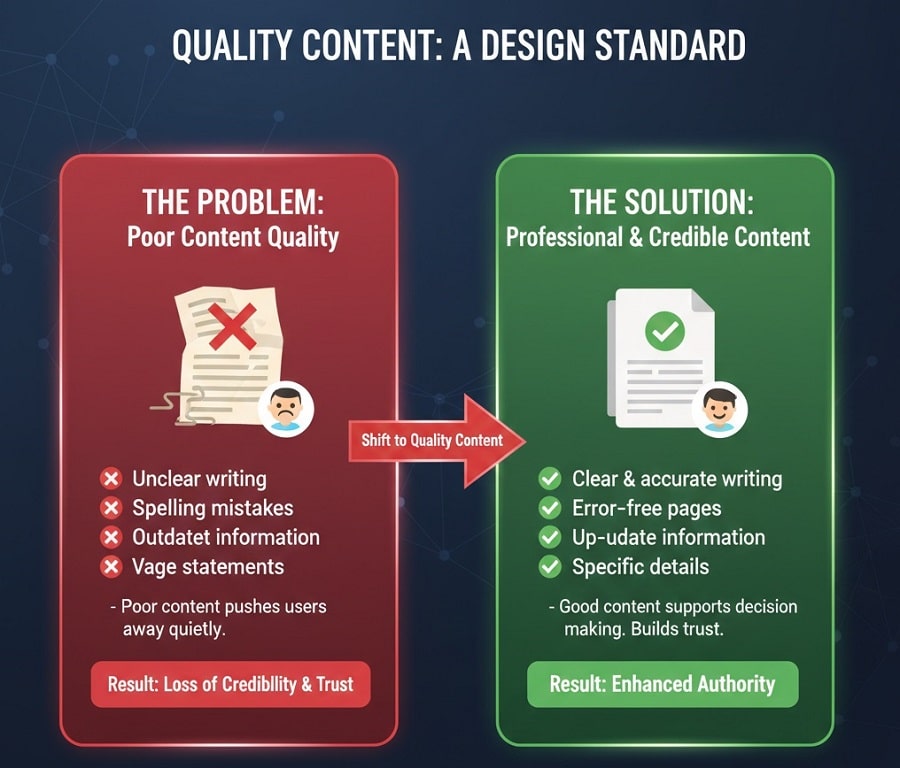
Content quality is a design standard, not just a marketing concern.
Clear writing, accurate information and error free pages all contribute to professionalism. Spelling mistakes, vague statements and outdated content undermine credibility.
Good content answers questions, sets expectations and supports decision making. Poor content pushes users away quietly.
UK Specific Design Considerations
Design standards are not universal. What works in one market does not always translate cleanly to another. UK audiences have specific expectations, and meeting them plays a big role in trust and conversion.
Language is one of the first signals. UK spelling, phrasing and tone matter. Americanised language can feel out of place or generic. Small details like this influence credibility more than most businesses realise.
Local trust expectations are also important. UK users often look for signs that a business understands the local market. This might include clear location information, familiarity with UK regulations or references that feel relevant rather than global and vague.
Regulatory awareness plays a role too. GDPR is a clear example, but it goes beyond privacy policies. Cookie consent should be functional and transparent. Forms should explain how data is used. These details reassure users that the business operates responsibly.
Pricing language is another area where UK standards apply. Clear pricing structures, transparent fees and honest explanations build confidence. Hidden costs or overly vague pricing language raise red flags quickly.
Professional credibility ties all of this together. UK users tend to be cautious. They look for reassurance, clarity and consistency before committing. Websites that meet these expectations feel safer to engage with.
Common Standards UK Websites Fail To Meet
Despite clear expectations, many UK business websites fall short in predictable ways.
Accessibility is often ignored. Text contrast is poor. Fonts are too small. Navigation relies heavily on hover interactions that do not work well on mobile. These issues quietly exclude users and reduce usability.
Overdesigned layouts are another problem. Excessive animation, visual clutter and complex layouts may look impressive but often distract from the message. Users struggle to focus on what matters.
Slow mobile performance is a frequent issue. Desktop experience may seem acceptable, but mobile users face delays and frustration. This is especially damaging given how much UK traffic comes from mobile devices.
Hidden contact details undermine trust. When phone numbers or email addresses are buried or missing, users hesitate. Transparency should never feel optional.
Vague messaging is one of the most damaging failures. When websites do not clearly explain what the business does or who it helps, visitors leave. Standards exist to prevent confusion, not create it.
How Website Standards Support SEO and Conversions
Website design standards are not separate from performance. They directly support SEO and conversion outcomes.
Better usability keeps users engaged longer. Clear navigation and fast load times reduce bounce rates and increase session depth. Search engines interpret this behaviour as a sign of quality.
Accessibility improvements often lead to cleaner structure and clearer content. This benefits both users and search engines by making pages easier to understand and index.
Trust signals such as consistent branding, security and transparency reduce hesitation. When users feel confident, they are more likely to take action.
Clear calls to action guide behaviour. Instead of hoping users will enquire, standards based design leads them naturally towards the next step.
When standards are followed, websites feel effortless to use. That ease translates directly into stronger conversion rates.
How Design Hero Builds Websites to UK Standards
At Design Hero, standards are built into the process from the start.
We begin with strategy. Understanding the business, the audience and the goal shapes every design decision that follows. Standards provide the framework, not the limitation.
UX, SEO and compliance are considered together. This avoids conflicts later and ensures the website works as a complete system rather than a collection of parts.
Design choices are intentional. Layouts guide attention. Content is structured for clarity. Mobile experience is prioritised rather than treated as an afterthought.
Clients work with one point of contact throughout. This keeps decisions clear and avoids diluted responsibility.
Everything we build is designed specifically for Scottish and UK businesses. We understand local expectations and design to meet them properly.
The result is websites that look professional, feel trustworthy and perform consistently.
Quick Website Standards Checklist
You can assess your own website quickly using this checklist.
- Is the website easy to use on a mobile phone?
- Do pages load quickly without frustration?
- Is navigation clear and intuitive?
- Is the site accessible and easy to read?
- Are privacy and cookie policies clear and functional?
- Does the website feel professional and trustworthy?
If several answers raise doubts, the website is likely falling short of modern standards.
Conclusion
Website design standards exist to protect performance, trust and credibility.
When standards are ignored, websites underperform quietly. When they are followed properly, websites support growth without friction.
UK businesses operate in a competitive environment where trust matters. A website that meets modern standards sets the right expectations and removes barriers to action.
If you are unsure whether your current website meets these standards, it is worth reviewing it honestly. Small gaps can have a big impact over time.
Design Hero helps businesses across Scotland and the UK build websites that meet expectations and outperform competitors. If you want clear, practical advice on improving your website to proper UK standards, we are always happy to talk.