

What Website Conversions Actually Depend On
Whether you run a service based business in Glasgow or an ecommerce store serving the entire UK, conversions rely on a small set of psychological triggers.
Clarity is the first. Visitors must understand what you do without effort. If they have to work to interpret your message, friction increases.
Trust is the second. Users must believe that you are legitimate, capable and reliable. Without trust, even a clear message will not convert.
Relevance is the third. Your offer must feel aligned with the visitor’s needs. Generic messaging fails because it speaks to no one in particular.
Confidence is the fourth. The user must feel comfortable taking the next step. This comfort is built through reassurance and alignment.
Branding influences all four of these factors simultaneously.
Clear positioning strengthens clarity. Consistent messaging reinforces relevance. Professional visual identity builds trust. Cohesive tone increases confidence.
When branding is weak, these foundational elements are unstable. You may attract traffic, but that traffic will not convert efficiently.
Branding is the First Conversion Filter
When someone lands on your website, they do not begin by analysing features. They begin by assessing risk.
Within seconds, visitors subconsciously evaluate whether your business feels credible. They scan visual cues. They interpret tone. They compare your presentation to other options they have seen.
This initial judgement determines whether they continue exploring or leave.
Branding shapes that judgement.
A website with inconsistent typography, mixed imagery styles and vague headlines communicates disorganisation. Visitors may not articulate that thought, but they feel it.
A website with cohesive visuals, focused messaging and confident tone communicates structure and professionalism.
In UK markets, where consumers often research carefully before committing, this early perception has a significant impact on conversion rates.
If your brand feels uncertain, your visitors will be uncertain.
How Branding Builds Trust in Practical Terms
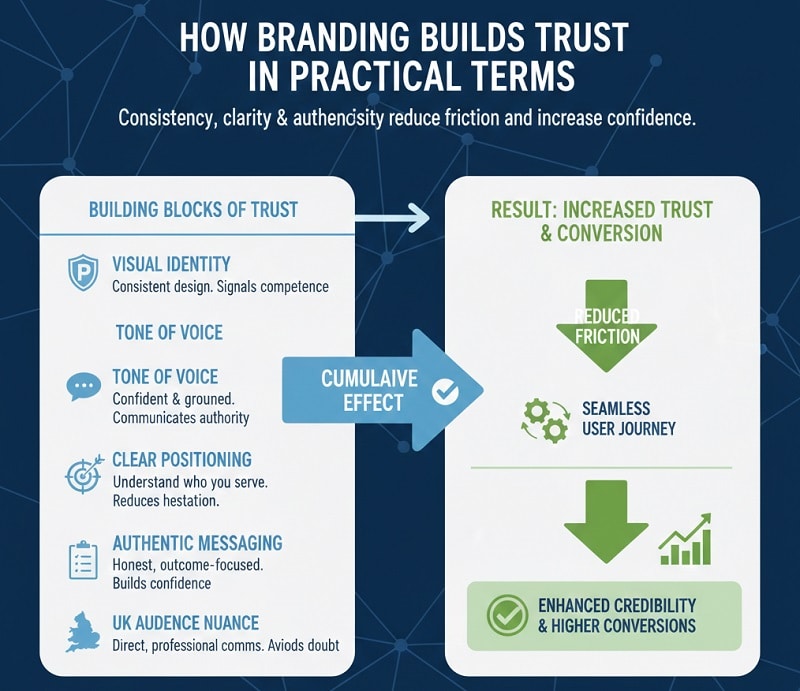
Trust is not built through a single testimonial or a security badge. It is cumulative. It develops through consistency and clarity.
A professional visual identity signals competence. When colours, typography and layout align, the business feels intentional. When visual elements clash or feel generic, credibility decreases.
Tone of voice also plays a central role. A brand that sounds confident but grounded communicates authority. A brand that swings between overly formal and overly casual creates instability.
Clear positioning reduces hesitation. If visitors instantly understand who you serve and what problem you solve, they do not need to guess whether you are relevant.
Authentic messaging strengthens reassurance. Overstated claims create scepticism. Honest, outcome focused language builds confidence.
For UK audiences in particular, exaggerated marketing language often triggers doubt. Direct, professional communication performs more effectively over time.
Trust reduces friction. Friction reduces conversions.
The Psychological Link Between Brand and Behaviour
Conversions are influenced by recognition and familiarity.
People are more likely to engage with brands they recognise and understand. Familiarity reduces perceived risk. Clear identity reduces cognitive load.
When branding is consistent across your website, social media and marketing channels, familiarity builds over time. Each exposure reinforces credibility.
Brand personality also influences emotional alignment. If your tone reflects your audience’s expectations and values, they feel understood. When users feel understood, they are more willing to act.
For example, a Scottish professional services firm that communicates integrity and clarity will resonate more strongly than one that relies on aggressive sales language. Cultural tone matters.
Branding shapes how your business is categorised in the visitor’s mind. If that categorisation is unclear, they hesitate.
Key Branding Elements That Influence Website Performance
To understand the direct impact on conversions, we need to examine the core branding components that shape online behaviour.
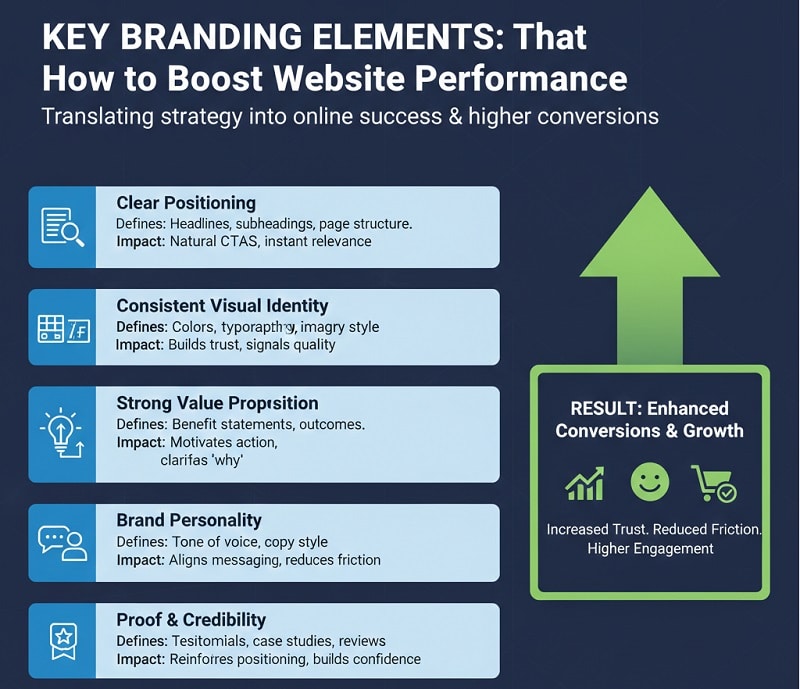
1. Clear Positioning
Positioning is the backbone of brand clarity. If a visitor cannot summarise what you do within a few seconds, your positioning is not strong enough.
On a website, positioning shows up in headlines, subheadings, service descriptions and benefit statements. It influences how pages are structured and which information is prioritised.
When positioning is sharp, calls to action feel natural. When positioning is vague, calls to action feel forced.
2. Consistent Visual Identity
Visual consistency reinforces professionalism. Cohesive colour palettes, typography systems and imagery styles create unity.
When different pages feel visually disconnected, users experience subtle doubt. This doubt reduces confidence.
Professional visual identity supports perceived quality. Perceived quality influences willingness to enquire or purchase.
3. Strong Value Proposition
A strong value proposition focuses on outcomes rather than features. It answers why your service or product matters.
Visitors convert when they see clear benefit. If your website explains process without clarifying results, motivation decreases.
Brand messaging must prioritise value over description.
4. Brand Personality
Personality humanises your business. It shapes how calls to action are phrased and how copy is structured.
If your brand personality is calm and consultative, your calls to action should reflect that tone. If your brand personality is energetic and growth focused, your language should align.
Misalignment between personality and action creates friction.
5. Proof and Credibility Signals
Testimonials, case studies and reviews must reinforce your brand positioning. If you position yourself as specialist, proof should highlight expertise. If you position yourself as accessible and supportive, testimonials should reflect approachability.
Brand and proof must tell the same story.
Signs Branding Is Hurting Your Website Conversions
Brand related conversion issues are rarely dramatic. They do not show up as broken forms or technical errors. Instead, they quietly reduce performance over time.
One of the clearest warning signs is inconsistent messaging. If your homepage sounds bold and confident but your services page feels cautious or vague, visitors sense a disconnect. That disconnect creates doubt.
Generic design is another issue. If your website looks similar to dozens of competitors using the same layouts and imagery, your differentiation disappears. When users cannot see what makes you distinct, they default to price or familiarity.
Confusing tone is equally damaging. If your brand tries to sound premium but your language feels informal and inconsistent, credibility weakens. Tone misalignment creates friction during decision making.
Weak differentiation is a major red flag. If your messaging could be copied and pasted onto a competitor’s website without much change, you are not communicating clear value. When users cannot see why you are different, they hesitate.
Mixed visuals also undermine trust. Inconsistent photography styles, clashing colours or outdated graphics make a business feel less structured. Visitors may not consciously analyse these details, but they influence perception immediately.
Branding problems often manifest as low engagement metrics, high bounce rates and steady traffic with weak enquiry levels. When the brand foundation is unclear, performance follows.
Branding and UX Must Work Together
Branding defines identity. UX defines how that identity is experienced.
If branding is the strategy, UX is the execution.
Messaging hierarchy directly informs layout. If your brand positioning is focused on a specific audience or outcome, your website structure must reflect that priority clearly. Services should be organised around user intent, not internal thinking.
Tone influences calls to action. A consultative brand should not use aggressive button language.
A bold, performance driven brand should not hide its offers behind soft messaging. Alignment matters.
Brand clarity also shapes user journeys. If your brand promises simplicity, your navigation must be simple.
If your brand promises expertise, your content structure should demonstrate depth.
When UX is developed without brand strategy, the result is often mechanical. It may function technically, but it lacks emotional coherence.
When branding is developed without UX consideration, it becomes decorative. It may look polished, but it does not guide behaviour.
The strongest performing websites integrate both from the outset. Structure supports identity. Identity reinforces structure.
The Commercial Cost of Brand Misalignment
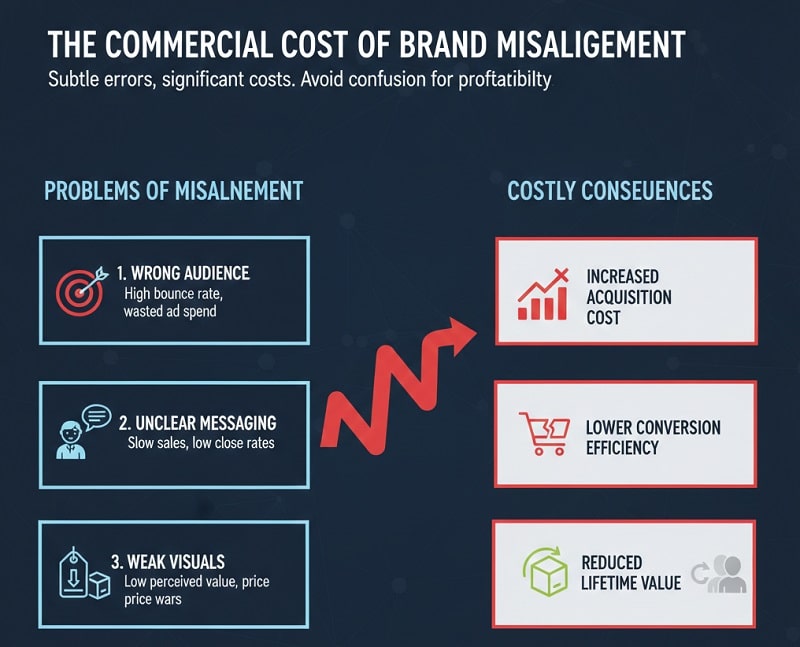
Brand misalignment is expensive, even when it is subtle.
When branding is unclear, marketing campaigns attract the wrong audience. That increases bounce rates and lowers return on ad spend.
When messaging is inconsistent, sales conversations require more explanation. This slows the buying process and reduces close rates.
When visual identity feels generic, perceived value drops. Businesses then feel pressure to compete on price rather than positioning.
For ecommerce brands, this often results in constant discounting to drive sales. Strong brands maintain margins. Weak brands rely on offers.
Misalignment also impacts long term growth. If customers do not clearly understand what you stand for, repeat engagement declines. Referral potential decreases.
In short, brand confusion increases acquisition costs, lowers conversion efficiency and reduces lifetime value.
The financial impact compounds over time.
A Real World Conversion Shift Through Brand Alignment
Consider a UK based service business experiencing steady traffic but inconsistent enquiries.
Before brand refinement, their messaging was broad and generic. Visual identity lacked cohesion. Testimonials were vague.
After refining positioning, clarifying value proposition and aligning visual identity, their website began communicating with precision.
Conversion rates improved not because of dramatic design changes, but because clarity increased.
Brand alignment reduced hesitation.
How Design Hero Aligns Brand and Website Performance
At Design Hero, branding and conversion strategy are integrated from the beginning.
We begin with positioning clarity. Who you serve. What differentiates you. What outcome you create.
We build messaging frameworks before designing visuals.
We create visual identity that reinforces strategic direction.
We design websites that translate brand clarity into logical user journeys.
Clients work with one consistent point of contact to maintain cohesion throughout the process.
For UK and Scottish businesses, tone and positioning must reflect local expectations while remaining competitive nationally.
Brand clarity drives measurable performance.
Want your website to align with your brand and boost conversions, Design Hero can Help – Book a free consultation
Quick Brand Conversion Audit
To assess your own website, consider:
- Can visitors understand what you do within seconds?
- Does your messaging remain consistent across pages?
- Do your visuals feel intentional and cohesive?
- Does your tone align with your target audience?
- Are testimonials reinforcing your positioning?
- Do calls to action feel aligned with brand personality?
If several answers feel uncertain, branding may be limiting your conversion potential.
Final Thoughts
Conversions are not simply technical outcomes.
They are trust based decisions. Branding shapes trust. It influences clarity, relevance and confidence.
When branding and website strategy work together, performance improves naturally.
When branding is treated as decoration, conversion suffers. For businesses across Scotland and the UK investing in growth, the link between branding and website performance cannot be ignored.
If your website is not converting as it should, the solution may not be more traffic or more design tweaks.
It may be brand clarity.