

What Brand Strategy Actually Includes
Before exploring how brand strategy influences website design, it is important to understand what brand strategy really means. Many people assume branding refers only to visual elements such as logos, colours and typography. In reality, those elements sit at the surface of a much deeper foundation.
Brand strategy defines how a business positions itself in the market and how it communicates value to its audience.
Positioning sits at the centre of that strategy. It clarifies where the business sits within its industry and what makes it different from competitors.
A clear position answers a simple but powerful question: why should someone choose this business instead of another option?
Target audience definition is equally important. Strong brands understand exactly who they are speaking to. They know the problems their customers face, the language those customers use and the outcomes they care about most.
The value proposition brings these insights together. It explains what the business offers, why it matters and how it improves the customer’s situation.
Without a strong value proposition, marketing messages often feel vague or interchangeable.
Messaging frameworks then translate strategy into communication. Headlines, taglines and supporting copy should consistently reinforce the same ideas across every channel.
Finally, brand personality shapes tone of voice and visual direction. Some brands communicate authority and professionalism.
Others emphasise friendliness and accessibility. The chosen personality influences everything from typography to imagery.
When these elements are clearly defined, they provide a strategic blueprint for the entire customer experience. Website design should follow that blueprint closely.
Why Websites Often Drift Away From Brand Strategy
Despite the importance of alignment, many websites fail to reflect their brand strategy accurately. This disconnect usually develops gradually during the design process.
One common cause is an excessive focus on visual aesthetics. Designers naturally care about layout, colour balance and visual appeal.
While these elements matter, they should never override strategic messaging. A visually impressive site can still perform poorly if it fails to communicate the brand’s value clearly.
Another issue arises when brand guidelines exist but are not properly applied. Some companies develop branding documents that define colours, fonts and tone, yet these guidelines are overlooked during website design. The result is a site that loosely resembles the brand but lacks consistency.
Messaging separation can also create problems. If website copy is written independently from brand strategy, the language may drift away from the intended positioning.
Headlines may become generic or overly technical, weakening the clarity of the brand’s value.
Communication gaps between teams frequently contribute to the issue as well. When branding consultants, designers and developers work in isolation, important strategic insights can be lost along the way.
Time pressure is another factor. Businesses eager to launch a new website sometimes skip strategic alignment discussions altogether.
The focus shifts toward completing pages quickly rather than ensuring they support the brand’s long term positioning.
These issues rarely occur because teams lack skill or effort. They happen because strategy is not consistently used as the guiding framework for design decisions.
The Role of Brand Strategy in Website Design
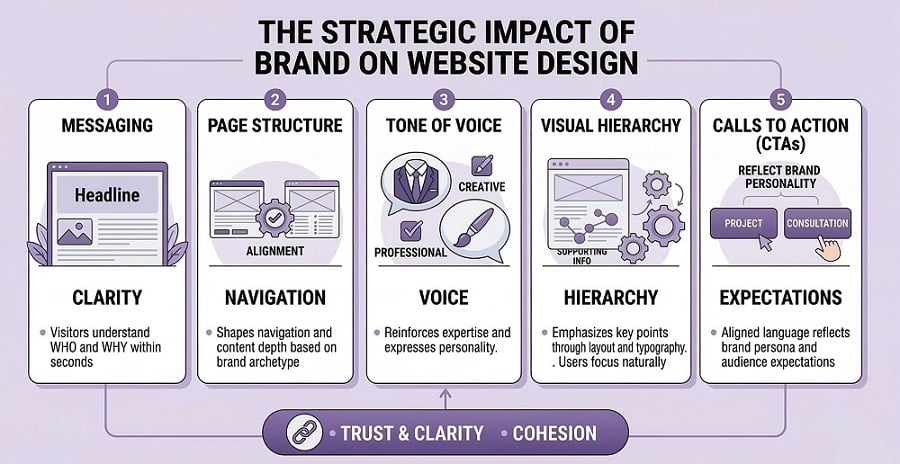
When brand strategy is applied correctly, it influences almost every decision made during the website design process.
Messaging is the most obvious starting point. The homepage headline, service descriptions and supporting content should reflect the brand’s positioning clearly
Visitors should understand within seconds who the business helps and why it stands apart from competitors.
Page structure is also shaped by brand strategy. If a brand emphasises simplicity and clarity, the website should reflect that through clean navigation and concise content.
If the brand positions itself as a specialist authority, deeper educational content and detailed service explanations may be appropriate.
Tone of voice plays a significant role as well. A professional consultancy may communicate with a formal tone that reinforces expertise.
A creative agency might adopt a more conversational style to express personality. The website’s written content should remain consistent with the brand’s voice.
Visual hierarchy further supports strategic messaging. Important ideas should be emphasised through layout and typography so that users naturally focus on key points.
Calls to action also benefit from strategic alignment. Some brands encourage direct action through confident language such as “Start Your Project”.
Others adopt a softer tone such as “Book a Consultation”. The choice should reflect the brand’s personality and audience expectations.
When brand strategy guides these elements, the entire website feels cohesive. Every page reinforces the same narrative, making it easier for visitors to understand and trust the business.
Key Elements That Must Stay Aligned
Maintaining alignment between brand strategy and website design requires careful attention to several core elements.
Messaging consistency is perhaps the most critical. Every page should communicate the same core value proposition and reinforce the same positioning. Inconsistent messaging confuses visitors and weakens credibility.
Visual identity must also remain consistent across the site. Colours, typography and imagery should follow brand guidelines closely. Sudden changes in visual style can make a website feel fragmented.
User experience should reflect brand personality as well. A premium brand might prioritise elegant design and refined visuals, while a technology company may emphasise clarity and efficiency.
Trust signals contribute to alignment too. Testimonials, case studies and certifications reinforce the credibility promised by the brand. Without these elements, visitors may question whether the brand’s claims are supported by evidence.
Finally, conversion strategy should align with the brand’s tone and goals. Calls to action should feel natural within the context of the brand rather than appearing overly aggressive or disconnected from the overall message.
When these elements work together, the website becomes a seamless extension of the brand rather than a separate digital asset.
Signs Your Brand and Website Are Not Aligned
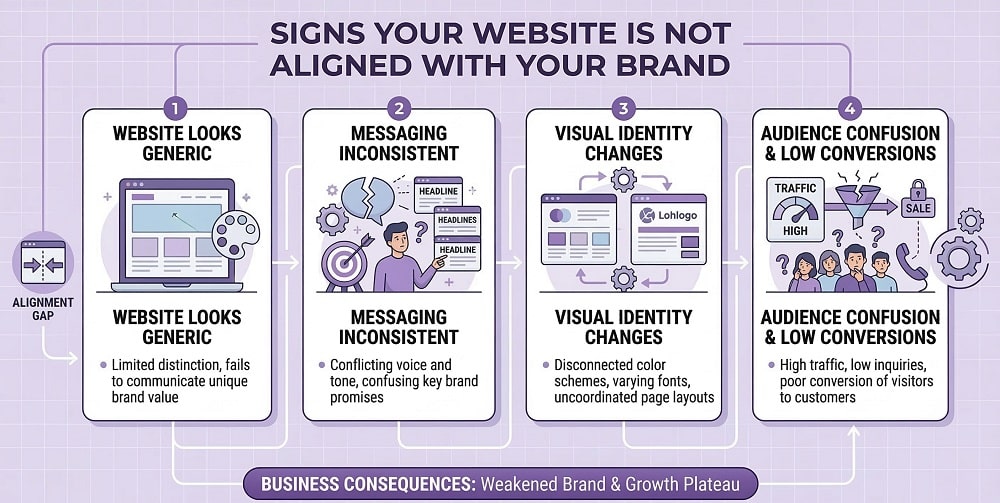
Brand misalignment is rarely obvious at first glance. A website may look professionally designed, contain all the expected pages and still feel slightly disconnected from the brand it represents. Visitors often sense this inconsistency quickly, even if they cannot explain exactly why.
One common signal is when the website feels generic. If the layout, imagery and messaging could easily belong to any competitor in the industry, the brand identity has not been translated effectively into the website design.
Strong brands feel distinctive. Generic design weakens that differentiation.
Messaging inconsistency is another indicator. The homepage may emphasise innovation while service pages adopt a more traditional tone.
Headlines might promise simplicity while the content itself feels overly technical. These inconsistencies make it harder for visitors to form a clear impression of the brand.
Visual identity issues also reveal misalignment. Colours, typography or imagery may vary across pages without clear reason. This creates a fragmented experience that subtly undermines credibility.
Audience confusion is perhaps the most serious consequence.
If visitors cannot immediately identify whether the brand is aimed at startups, enterprise clients or a niche sector, they may assume the business lacks focus. A strong website clarifies the target audience instantly.
Low conversion rates despite healthy traffic are another warning sign. When marketing efforts successfully attract visitors but enquiries remain low, the issue often lies in the way the brand is communicated on the website.
Recognising these signals early allows businesses to correct misalignment before it begins affecting growth more significantly.
The Impact of Brand Alignment on Conversions
Brand alignment does not only improve aesthetics. It directly influences how visitors behave.
When brand strategy and website design work together, visitors experience clarity from the moment they land on the homepage.
They understand what the business offers and who it is for. This clarity reduces cognitive effort, allowing users to move quickly toward a decision.
Trust increases as well. Consistent messaging and visual identity signal professionalism and attention to detail. These signals reassure visitors that the business is organised and credible.
Aligned branding also strengthens emotional connection. When tone of voice, imagery and messaging reflect the brand personality accurately, users feel they are interacting with a coherent organisation rather than a collection of disconnected pages.
This combination of clarity, trust and emotional resonance increases the likelihood of action. Visitors feel more comfortable completing enquiry forms, booking consultations or making purchases.
Brand alignment also improves marketing performance. Advertising campaigns, social media activity and SEO efforts all direct visitors to the website.
If the website communicates the same message as those campaigns, the transition feels seamless. Users recognise the brand they clicked on and continue their journey confidently.
When alignment is missing, the opposite happens. Visitors arrive expecting one experience and encounter another. That moment of confusion often leads to abandonment.
For businesses investing in digital marketing, ensuring brand alignment across the website is therefore essential for maximising return on investment.
How Design Hero Aligns Brand Strategy With Website Design
At Design Hero, brand strategy and website design are never treated as separate projects. They are considered two parts of the same system.
The process begins with understanding the business itself. Who are the ideal customers? What problems does the business solve? What differentiates it from competitors in the UK market? These insights define the strategic foundation.
Messaging development follows. Clear value propositions, headline frameworks and tone of voice guidelines ensure that the brand communicates consistently across all digital touchpoints.
Website structure is then designed to support that messaging. Navigation, page hierarchy and content flow are mapped to guide users naturally from introduction to enquiry.
Visual design reinforces the brand identity rather than distracting from it. Colour palettes, typography and imagery are chosen to reflect the personality and positioning defined during the strategy phase.
Conversion optimisation is integrated throughout the process. Calls to action are positioned carefully. Trust signals such as testimonials and case studies are incorporated where they have the greatest impact.
Working with a single point of contact ensures that strategic decisions remain consistent from discovery to launch. Instead of multiple disconnected teams, businesses benefit from a streamlined approach where branding and website design evolve together.
For companies across Scotland and the UK, this integrated approach produces websites that not only look professional but also communicate clearly and perform commercially.
Want your website to align with your brand? Contact Design Hero for Free consultation
Brand Alignment Checklist for Websites
Use this checklist to assess whether your website design truly reflects your brand strategy.
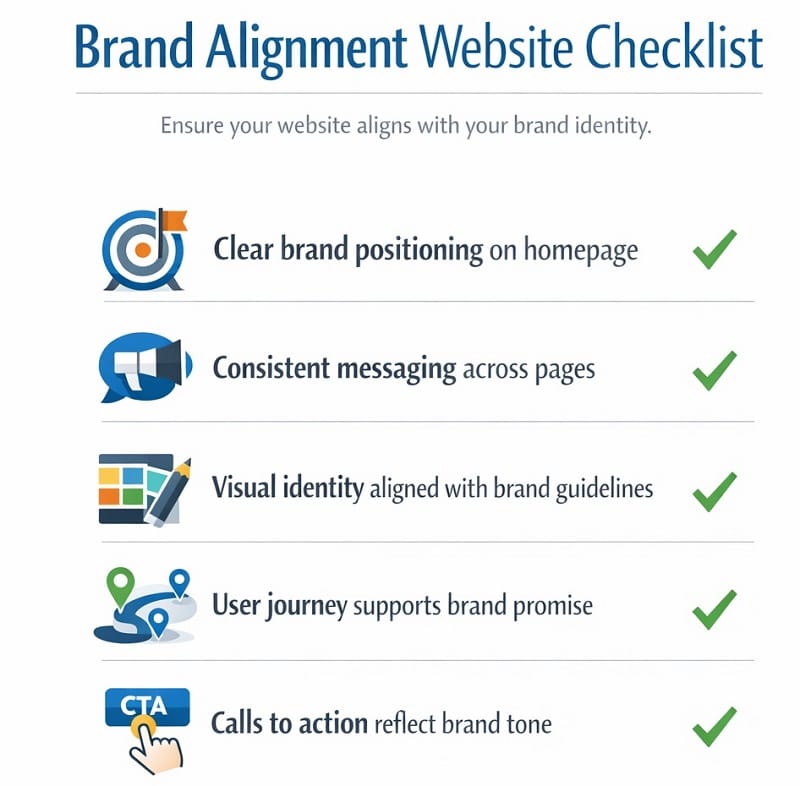
- Clear brand positioning on the homepage: Visitors should understand what your business does and who it helps within a few seconds of landing on the site.
- Consistent messaging across all pages: Headlines, service descriptions and calls to action should reinforce the same core value proposition.
- Visual identity follows brand guidelines: Colours, typography and imagery should remain consistent across every page to maintain a cohesive brand experience.
- User experience reflects the brand personality: Navigation, layout and structure should support how the brand presents itself. A brand focused on simplicity should feel easy and intuitive to navigate.
- Design quality matches brand positioning: If the brand is positioned as premium, the website should reflect that through refined visuals, careful spacing and professional presentation.
- Calls to action match the brand tone: Button language and prompts should align with the brand voice. Overly aggressive messaging can weaken brands built around trust or expertise.
- User journeys support the brand promise: Visitors should move naturally through the website toward the next step without confusion or unnecessary friction.
- Content reinforces the same story throughout the site: Service pages, case studies and supporting content should all support the same brand narrative.
- Trust signals reflect brand credibility: Testimonials, case studies, certifications or reviews should support the claims made by the brand.
- Marketing channels and website messaging match: Visitors arriving from ads, social media or search should experience the same message and tone on the website.
If several of these areas feel inconsistent, the website may require strategic realignment.
Final Thoughts
A strong brand without a strong website creates missed opportunities. A well designed website without a clear brand strategy creates confusion.
For businesses across Scotland and the UK, the most effective digital experiences are built when brand strategy and website design operate together. Strategy defines direction. Design communicates that direction clearly.
When alignment exists, every element of the website reinforces the same message. Visitors understand the brand quickly.
Trust develops naturally. Conversions increase because users feel confident about the business behind the website.
Achieving this level of alignment requires more than attractive design. It requires strategic thinking, clear messaging and structured user journeys.
For companies planning a new website or redesign, the most valuable question is not simply how the website will look. It is how effectively the website will represent the brand.
When brand and website operate as one system, the result is not just a better looking website. It is a more effective business tool.
If your website feels disconnected from your brand or struggles to convert visitors into enquiries, it may be time to review how strategy and design work together.
A clear conversation can often reveal opportunities to strengthen both.